
What works instead is the crypto option. OpenRouter turns your top-up into a payment link, and ROZO Checkout lets you pay that link with USDT or USDC on Solana, BNB Chain, Ethereum, Polygon or Arbitrum, USDC on Base or Stellar, or Bitcoin over Lightning. No card and no ROZO account. Payment methods can change, so check the current payment page before you treat this as permanent.
ROZO Checkout is independent and not affiliated with OpenRouter, Coinbase, Boltz or PayPal.
Which option fits you
Pick the line that matches what you actually have. Each link opens the guide for that route.
- I only have a PayPal balance.
There is no direct route from a PayPal balance to OpenRouter credits. You first need USDT, USDC or Bitcoin in an account or wallet you control. - I have a PayPal debit card.
It is still a card and goes through the same card checkout. If cards keep failing for you, start with the decline guide. - I have USDT or USDC on an exchange.
Withdraw it to the one-time deposit address ROZO shows for your OpenRouter link. No browser wallet needed. - I have a Bitcoin Lightning wallet.
Pay the Lightning invoice ROZO shows for your OpenRouter link. - I only have GCash or another local mobile wallet.
OpenRouter does not accept it directly. Buy a small amount of crypto through a local exchange first. - OpenRouter's card checkout does not work in my country.
A step-by-step decision tree through the official paths and the card-free options.
What the credits page actually offers
We are not going to guess at OpenRouter's reasons for the methods it supports; only OpenRouter can say why its checkout looks the way it does. What matters for you is what is on the page: at the time of writing, a card path and a crypto path, and no PayPal path that a setting can unlock.
That leaves two practical questions: whether anything PayPal-adjacent gets you onto one of those two rails, and what to do if the card rail is exactly what has been failing you.
The PayPal workarounds
A PayPal-linked debit card. If you hold one, it presents at checkout as a card and goes through the card path like any other. Whether it is approved depends on the issuer behind it and on the processor's own checks, so the outcome may or may not differ from the card you already tried. Either way it does not get you off the card rail.
A PayPal balance in general. At the time of writing there is no route that turns a PayPal balance into an OpenRouter credit purchase directly. Whatever you do with it, it has to end up on one of the two rails the checkout does offer.
If you already hold crypto anywhere (an exchange account, a self-custody wallet, a Lightning wallet), you can skip straight to the route below.
What actually works: skip the card rail
At the time of writing, OpenRouter's crypto option produces a Coinbase-hosted payment link, and that link is narrow: it accepts USDC on Base. So even if you already hold coins somewhere, you can be looking at a link you cannot pay directly. Check the current payment page for the network it asks for.
That gap is what ROZO Checkout closes. It settles the same OpenRouter link using the coin you already hold, on the chain you already hold it on.
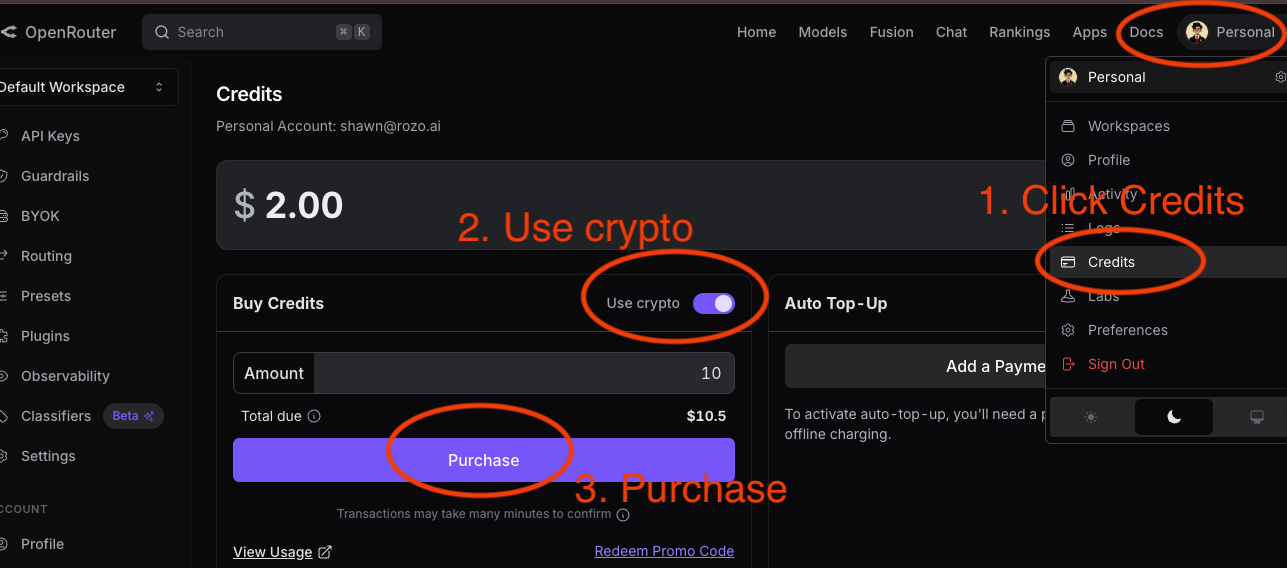
- In OpenRouter, open Settings then Credits, turn on the crypto option, enter the amount, and click Purchase. Copy the payment link it produces.
- Paste that link at checkout.rozo.ai.
- Pick what you hold: USDT or USDC on Solana, BNB Chain, Ethereum, Polygon or Arbitrum; USDC on Base or Stellar; or Bitcoin over Lightning, from any wallet that can pay a standard Lightning (BOLT11) invoice.
- Send the quoted amount to the one-time deposit address shown, or pay the Lightning invoice. If your funds sit on an exchange, you can usually withdraw them straight to that address, though some exchanges restrict withdrawals to addresses you have verified as your own.
- A funder wallet settles the checkout invoice. Credits are applied after the payment settles on chain; the ROZO payment page shows live status until it does.
There is no ROZO account to create, no card, and no KYC form. OpenRouter's own crypto fee, around 5% as listed on OpenRouter's FAQ at the time of writing, is already built into the link, and ROZO charges a 1% service fee shown before you confirm. ROZO sets no minimum of its own; OpenRouter's validation on the link is the limit that applies.
Native coins are accepted too: ETH on Ethereum, Base or Arbitrum, BNB on BNB Chain, SOL on Solana and POL on Polygon. ZEC on Zcash is in Beta and has its own page: checkout.rozo.ai/zec. A native coin order carries the 1% service fee plus an FX spread on the coin price, built into the coin amount. On-chain BTC is not accepted; for Bitcoin, use Lightning.
If you have no crypto at all
The honest answer is that you need to acquire some first. The two common starting points are an exchange account, where you buy USDT or USDC and withdraw it to the deposit address, or a Lightning wallet you fund with a small amount of Bitcoin. Once the funds are in your control the OpenRouter link is payable. Credits are applied after the payment settles on chain; the ROZO payment page shows live status until it does.
If the reason you wanted PayPal was that cards keep failing rather than that you prefer PayPal, the crypto route is the direct fix, because it does not touch the card rail at all.