
This is a survey of what actually works in 2026, ranked, with the tradeoffs stated plainly. We build one of the options listed here and we say so where it appears. We are not going to pretend the others do not exist or are worse than they are; this audience checks.
Verified on 10 August 2026.
The constraint, stated honestly
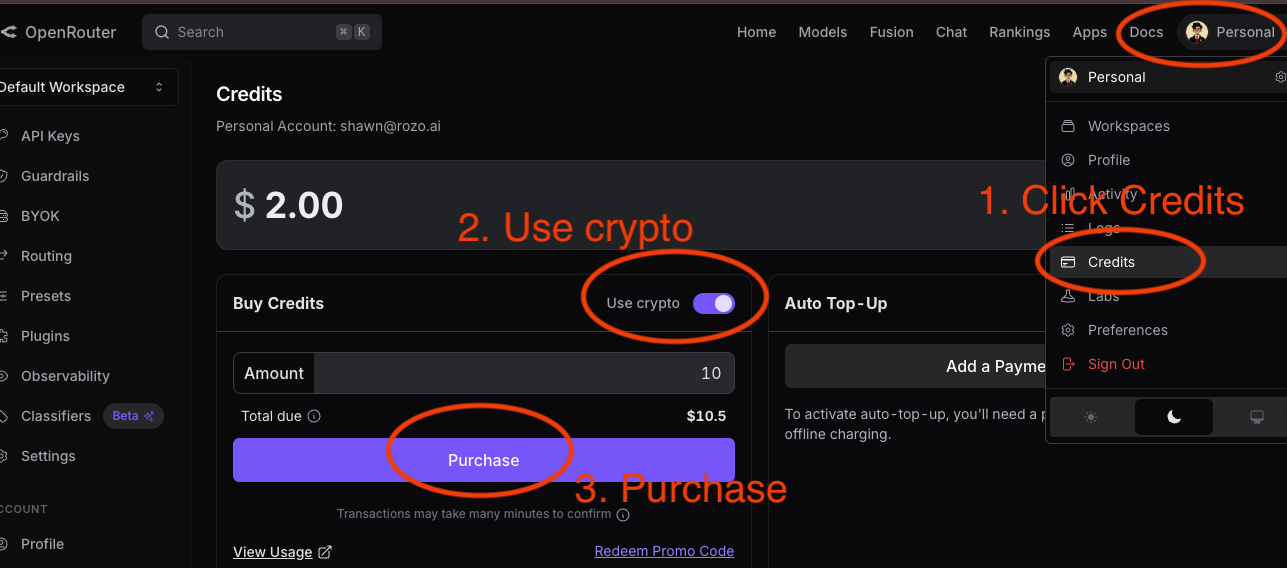
OpenRouter — the router most people asking this question are asking about — accepts cards, some regional rails, and stablecoins through a hosted crypto checkout. Its native crypto path carries a fee in the region of 5%, and it does not accept Bitcoin or Lightning at all. Anthropic, OpenAI, and the rest are card-only.
So every route below is a workaround. There is no first-party pay-with-Bitcoin button on the major providers, and there probably will not be one soon — the market is consolidating onto fiat rails, not away from them.
That is the wedge the Bitcoin-native side of this is built on, and it is why the alternatives below exist at all.
Why Lightning suits online and agent purchases in particular
Before the routes, it is worth saying why this is a Bitcoin-shaped problem at all, because the answer is not ideology.
Buying inference is small, frequent, remote, and delivered instantly. Two properties of card rails bite on that shape. Card pricing usually carries a fixed component on top of a percentage, so a $2 top-up can lose double digits to fees before anything else happens, while Lightning routing fees are typically a few sats plus a small proportional part — they grow with the amount, but nothing like a fixed floor does at the small end. Cards also settle provisionally: the chargeback window can stay open for months after the credits have already been spent. That reversal exposure is one of the reasons processors treat AI credits as a higher-risk category, alongside fraud rates, merchant history, and compliance screening — it is not the only one. A Lightning payment is final within seconds, so the seller can release the credits immediately without pricing in a reversal.
Geography is the other half, with a caveat worth stating plainly. The Lightning network itself has no opinion about where you are — an invoice is either paid or it is not, and there is no issuer in the middle declining it for your country. What that does not do is override the provider's own rules. Route 1 still needs an account and a payment link from the provider, and checkout operators, wallets, and mints all run their own compliance. Lightning changes which payment instrument you can use; it does not change whether the provider will serve you.
The part that matters most for what is coming is how cleanly a Lightning payment automates. A bolt11 string is a self-describing payment request — destination, expiry, and usually an amount, though amountless invoices exist — so a program holding a funded wallet can settle one directly, with no interactive challenge in the path. Cards are not incapable of this: card-on-file credentials, network tokens, and merchant-initiated transactions are all routinely machine-operated. The difference is what each one requires standing behind it. Automating cards means a merchant relationship, a stored credential, and an issuer willing to approve the charge; paying an invoice needs a wallet with a balance. Neither side is free, though. Automating Lightning still needs a programmatically controllable wallet, liquidity that can actually route the payment, and a seller or intermediary that issues Lightning invoices at all — and on Route 1 that intermediary still needs the provider account and payment link. The honest summary is that the requirements are different in kind, not that one side has none. It is also why the ecash work in Route 2 is worth watching rather than dismissing: a Cashu token is a bearer instrument an agent can hold and spend without holding an account anywhere.
The honest limits. You need a funded Lightning wallet before any of this helps, refunds are a conversation rather than a one-click reversal, and a wallet or route short on liquidity can simply fail to pay a large invoice. And someone always carries the exchange-rate risk: a bolt11 invoice is denominated in bitcoin, so a seller who receives and holds sats stays exposed after the payment settles. On Route 1 the provider is shielded because the checkout converts to stablecoins on your behalf — which moves that short-term risk onto the checkout operator rather than removing it. We are one of those operators, so take that as disclosure rather than a selling point.
Route 1: Lightning to credits, via a third-party checkout
What it is. You take the provider's payment link, hand it to a checkout that accepts Lightning, pay a Lightning invoice from any wallet, and the checkout settles the stablecoin side on your behalf. Credits land in the provider account you already have.
Why it ranks first. It is the fastest and cheapest route for most amounts, and it is the only one where you pay in sats and are done in one step. Settlement is typically 30 to 90 seconds for the swap plus provider crediting. On a $100 payment the all-in cost through a well-routed Lightning-to-stablecoin swap runs under 1% — meaningfully cheaper than the roughly 5% the native crypto path charges.
For full disclosure: this is what we build. ROZO Checkout at checkout.rozo.ai takes an OpenRouter payment link and pays it from Lightning. We built the Lightning route because Bitcoin holders kept asking for it, which is what the Nostr crowd has been saying for a year: given a Lightning option, people holding sats use it.
KYC. None on the checkout itself. You are not creating an account with the checkout. You do still need an account with the AI provider, which is the real identity surface in this route and no third-party checkout can remove it.
Watch out for. Use a Lightning wallet, not an on-chain Bitcoin wallet — this is the number one user error. And a Lightning payment is final; if the downstream settlement gets stuck, you are relying on the operator to resolve it, not on a chargeback.
Route 2: Cashu ecash, where the token is the API key
What it is. Instead of an account, you hold a bearer ecash token. You deposit sats over Lightning into a Cashu mint, receive ecash, and hand that ecash to an inference endpoint as your credential. Cost is deducted per request against the token's balance; whatever is unspent, you withdraw.
Why it matters. This is the only route on the list that removes the account entirely. No email, no login, no provider-side identity, no balance that can be frozen, because the thing holding value is in your pocket. It maps exactly onto the HTTP 402 pattern and onto NIP-60/61 wallets on Nostr. If your objection to the status quo is structural rather than about fees, this is the only structurally different answer here.
The live implementation is Routstr — an OpenAI-compatible decentralised routing marketplace where providers advertise over Nostr, payment is Cashu, and the ecash token functions as the API key. It is an OpenSats grant recipient, it is in live beta, and providers can back it with their own upstream API keys or with local hardware.
What to expect. Routstr is a live network that grows with the people running it: providers publish themselves to a Nostr relay, so the model menu reflects who is serving right now rather than a fixed catalogue. Check the current provider list for the models your work needs before you point production at it, the same as you would with any routing layer. If the no-account property is what you want, it works today — and every request through it is what brings more providers in.
KYC. None, genuinely — this is the strongest no-KYC option on the list. Mint custody is the tradeoff: a Cashu mint holds the sats backing your ecash, and mints are trusted parties. Do not park large balances in one.
Route 3: Bitcoin to prepaid card to provider
What it is. Buy a virtual Visa or Mastercard with Bitcoin at a service such as Bitrefill, then pay the AI provider as a normal card transaction.
Why it is on the list. It is the only route that works with every provider, including the card-only ones. If you want to pay Anthropic or OpenAI directly with sats, this is essentially the answer.
Costs and friction. You pay a card-issuance spread plus the provider's own card processing, so total cost is typically the worst on this list — call it 5% to 10% all-in depending on the issuer. Cards also get declined by AI providers with some regularity, especially prepaid BINs and especially where the billing country does not match. Budget for at least one failed attempt.
KYC. Partial. Gift-card and prepaid services vary enormously; some are no-KYC under a threshold, some are not. Verify before funding, not after.
Route 4: Swap to the stablecoin the provider wants
What it is. Sell sats for USDC on the exact chain the provider's invoice specifies, then pay natively.
When to use it. Large amounts where you want to be inside the provider's own support boundary. If something goes wrong on a first-party payment, the provider owns the problem. On every other route, resolving a stuck payment involves at least two parties.
Costs. Swap spread, plus network fees, plus the provider's crypto path fee where one applies. Usually worse than Lightning-direct and better than gift cards.
The trap. The chain-and-token matching problem is brutal here. Sending the right token on the wrong network produces a transaction that confirms on-chain and credits nothing, with recovery that is discretionary and slow. If you take this route, confirm the network name and the token contract on the checkout page before you touch your wallet.
KYC. Depends entirely on where you swap. A centralised exchange is full KYC. A non-custodial swap is not.
Tradeoffs at a glance
Lightning through a third-party checkout: under 1% all-in at $100, 30 seconds to 3 minutes, no KYC at the checkout but the provider account is still required, works with providers that issue payment links such as OpenRouter. Main risk: you are trusting an operator to settle, and Lightning payments are final.
Cashu ecash via Routstr: priced per request by the market, instant, genuinely no KYC, works within the Routstr provider set. Main things to check: which models are being served right now, and mint custody.
Bitcoin to prepaid card: roughly 5% to 10%, minutes to hours, partial KYC that varies by issuer, works with everyone including card-only providers. Main risk: card declines and the worst pricing on the list.
Swap to stablecoin: 1% to 6%, minutes, KYC depends on the venue, works with providers that have a crypto checkout. Main risk: wrong-network sends are hard to recover.
Choosing, in one paragraph
If you want the cheapest sats-to-credits path on a provider that has a payment link, use Lightning through a checkout that accepts it. If your objection is to accounts and identity rather than to fees, use Cashu and pick from the providers serving on the relay today. If you need a card-only provider, buy a prepaid card with Bitcoin and expect to pay for the privilege. If you are moving a large amount and want the provider's own support to own any failure, swap to the exact stablecoin and chain the invoice names — and triple-check the network.
What we would like to see change
Two things would collapse this whole page into one sentence. First, AI providers accepting Lightning natively — the rails are mature, the settlement is faster than card, and the chargeback risk is zero, which is exactly the property a usage-billed API wants. Second, the 402-plus-ecash pattern reaching the point where whichever model you want is already being served. The second is being built right now by the Nostr and Bitcoin community; the first will happen when enough people ask.
Until then, everything above is a workaround, and we would rather say that clearly than dress one of them up as the answer.
ROZO builds one of the options described above and is independent of OpenRouter, Routstr, and the wallet software named here.