ROZO Checkout exists to remove that toll. You paste your OpenRouter payment link, pick whichever chain or token you already hold, confirm in your own wallet, and the payment settles to USDC automatically. ROZO currently charges no service fee while we validate the flow, which means the amount you send is the amount that becomes credits.
This page is the hub. It covers what every method has in common, what each one costs, how long each one takes, and which wallets work. Pick the chain or token you already hold and follow the step-by-step guide linked at the bottom of the relevant section.
OpenRouter is sometimes searched or typed as Openrounter, Open Router, OpenRoute, Openroutor, or Openrooter. However you spell it, the same methods below apply.

Does OpenRouter accept crypto directly?
Yes, but with a cost attached. OpenRouter's own crypto payment path charges 5%. On a $100 top-up that is $5 that never becomes credits. On a $1,000 top-up it is $50. For a developer who is already holding stablecoins and simply wants them turned into API credits, that is a meaningful tax on doing nothing more complicated than moving money from one place to another.
There is also a scope limit. OpenRouter's balance is denominated in USDC. If your money lives as Bitcoin, or as USDT on BNB Chain, or as USDC on Stellar, you are not just paying a fee, you are also being asked to convert first. That means an exchange account, a bridge, a withdrawal, and a wait, all before you reach the top-up screen.
ROZO Checkout is a third-party checkout that sits in front of the OpenRouter payment link and handles both problems at once. You pay from the asset and the chain you already hold, and ROZO settles the result to USDC on your behalf. ROZO is independent and is not affiliated with OpenRouter, Coinbase, or Boltz.
What it costs
This is the part worth being blunt about, because it is the only reason most people arrive at this page.
OpenRouter's own crypto payment path charges 5%.
ROZO currently charges no service fee while we validate the flow.
That is the whole comparison. The one cost that does still exist on any route is the underlying network fee charged by the blockchain itself, and that is paid to the network, not to ROZO. On Solana it is a fraction of a cent in SOL. On Stellar it is a tiny fraction of a cent. On BNB Chain it is a small amount of BNB. On Lightning the routing fee is negligible on typical top-up sizes. None of that money goes to ROZO.
Because the order is priced in USDC, the USD value you owe is fixed at the moment the order is created. Paying in sats does not expose you to the price move between reading the invoice and confirming it, because the invoice is denominated for you in the exact number of sats that satisfies the USDC total.
Every method starts the same way
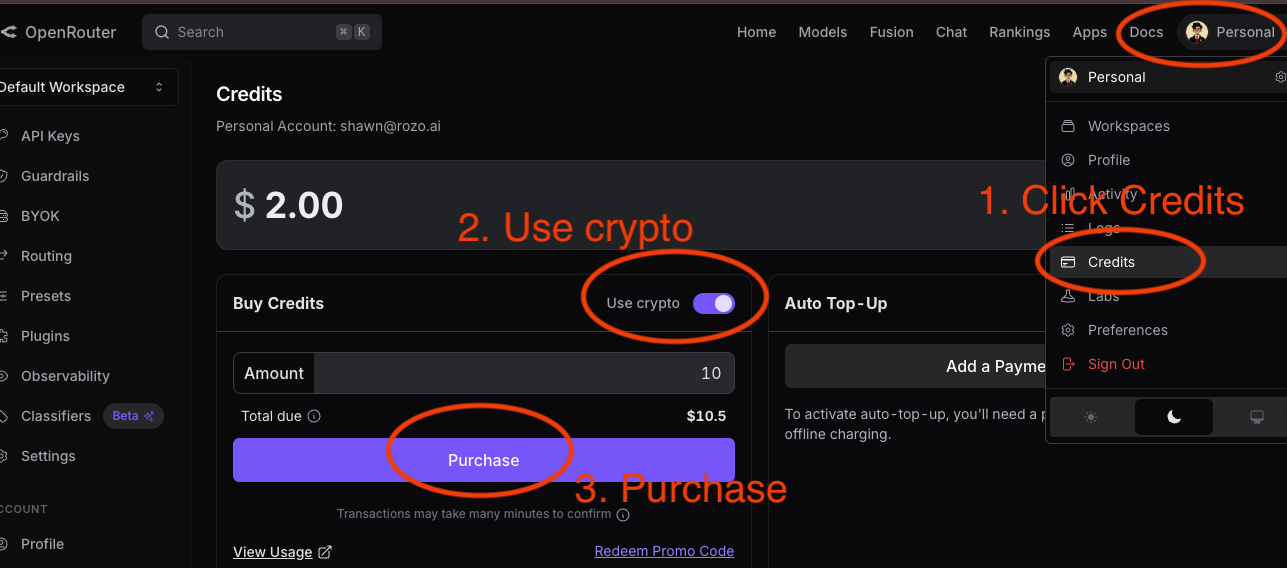
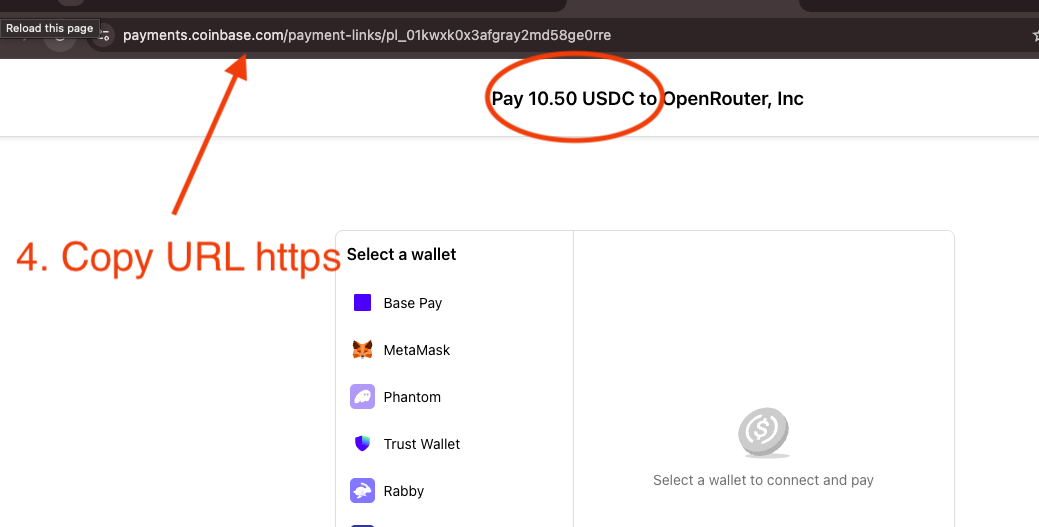
- Copy your OpenRouter payment link or payment ID.
- Paste it into ROZO Checkout.
- Pick the chain or token you want to pay with.
- Confirm in your wallet. Credits are added automatically.
The order is always priced in USDC, so the USD value is fixed no matter which coin you pay with. Payments settle to USDC for you.
Step 1 is the one people ask about most. The payment link is generated on OpenRouter's side when you start a top-up, and it looks like a short identifier such as pl_01kyaaevc7evgt9. You can paste either the full URL or just the identifier into ROZO Checkout, whichever is easier to get onto your clipboard. Everything after that happens inside your own wallet.
There is no ROZO account to create, no email to verify, and no KYC form standing between you and step 4. The checkout is a payment surface, not a custodial platform, and it does not hold a balance for you.

Choose how to pay
Bitcoin (Lightning): pay from any Lightning wallet, credits in about 3 minutes. USDC or USDT on Solana: connect Phantom, Solflare, or Backpack and approve in-wallet. USDC on Stellar: fast, very low fee stablecoin payments. USDT on BNB Chain: pay from the BEP-20 USDT you already hold.
Pick your method from the links below for the exact steps.
A short way to decide. If your money is in Bitcoin, use the Lightning route, and make sure you are sending from a Lightning wallet rather than an on-chain one. If you already hold stablecoins in a Solana wallet, the Solana route is the least friction because it is a wallet-connect flow with nothing to copy and paste. If you want the cheapest and fastest settlement available and you already have a Stellar account, use USDC on Stellar. If your working capital sits in BEP-20 USDT, use BNB Chain and pay straight out of it.
There is no penalty for picking the wrong one first. If the token you selected turns out to be short of the order amount, the checkout tells you before you sign anything and you can switch.
Which wallets work
Bitcoin over Lightning works with any Lightning wallet. Wallet of Satoshi, Phoenix, Muun, and Breez are all common choices, and the checkout gives you a scannable QR code plus Open in wallet and Copy invoice buttons so you can use whichever one you have installed. The only hard requirement is that it must be a Lightning wallet, not an on-chain Bitcoin wallet.
Solana works with Phantom, Solflare, and Backpack. These connect directly to the payment window, which means the checkout drives the transfer through your wallet rather than asking you to send funds to a pasted address. Keep a small amount of SOL in the wallet for the network fee.
BNB Chain works with MetaMask, Rabby, and Trust Wallet, paying in BEP-20 USDT. Keep a small amount of BNB in the wallet for gas.
Stellar works from your existing Stellar account holding USDC on Stellar, and the checkout is also reachable at checkout.rozo.ai/stellar for people arriving from the Stellar community.
Across all four, the wallet you already use is almost certainly on the list. There is no ROZO-specific wallet to install.
How long it takes
Speed differs by rail, and it is worth knowing what to expect so you do not refresh the page in a panic thirty seconds in.
Stellar confirms in a few seconds. It is the fastest of the four and also the cheapest, with fees that are a tiny fraction of a cent.
Solana usually credits within about 30 seconds, once the payment confirms on-chain.
Bitcoin over Lightning usually credits in about 3 minutes. The Lightning invoice itself expires in about 60 minutes, so pay while it is fresh rather than leaving the tab open overnight and coming back to it.
BNB Chain lands after the BEP-20 transfer confirms, which is typically quick but depends on network conditions at the time.
In every case, credits are added automatically once the payment confirms. You do not have to send a receipt to anyone or open a ticket to have the balance applied by hand.
If credits do not arrive
The first thing to do is wait for the expected window to actually pass. Lightning takes about 3 minutes and Solana about 30 seconds, so a payment that is forty seconds old on Lightning has not failed yet, it is simply still in flight.
The second thing is to keep your payment record. On Lightning that is the payment record in your wallet. On Solana, Stellar, or BNB Chain it is the transaction hash, which every wallet exposes in its activity list and which you can copy in one tap. That record is the single most useful piece of information for resolving anything, because it proves both the amount and the destination.
The third is to check the obvious mismatches before assuming something broke. Did you pay from a Lightning wallet rather than sending on-chain Bitcoin? Did you pay the invoice before its roughly 60-minute expiry? Was the token you selected the one you actually hold, rather than a same-named token on a different chain?
If the window has passed and the payment record shows a confirmed send, contact support with the payment record and the OpenRouter payment link or payment ID. Those two things together are enough to trace and resolve it.
Is it safe, and who is ROZO?
ROZO Checkout is a payment surface. On the wallet-connect routes, which covers Solana and BNB Chain, you approve a transfer inside your own wallet and the checkout never holds your keys. On the Lightning route you pay an invoice that displays the exact amount in sats before you confirm, so the amount you are agreeing to is visible in your own wallet rather than being assumed on your behalf.
Under the hood, the Bitcoin path is powered by Coinbase Payments and Boltz, which is what converts your Lightning payment into the USDC that OpenRouter expects. Those are the components that do the settlement work on that particular rail.
ROZO is independent. It is not affiliated with OpenRouter, Coinbase, or Boltz, and it does not represent itself as an official OpenRouter payment method. It is a third-party checkout that accepts crypto you already hold and settles the result to USDC so that OpenRouter can credit your account.
The pricing position is deliberately simple while the product is young. OpenRouter's own crypto payment path charges 5%. ROZO currently charges no service fee while we validate the flow. If that changes, it will be stated plainly rather than buried, because the entire reason people try this route is the cost.