
The first route puts a card in the middle: you buy a prepaid or virtual card with crypto, the provider holds that balance for you, and you then pay OpenRouter with the card. The second route has no card at all: you pay the merchant's payment link directly from your own wallet.
This page is about the second one. It covers what you need, what you do not need (a card, an account, a KYC form), and the structural reason those are absent rather than merely waived.
ROZO Checkout is an independent third-party checkout. It is not affiliated with OpenRouter or Coinbase.
The two models, side by side
Route one, the card route:
- Buy a prepaid or virtual card using crypto.
- The provider holds that balance until you spend it.
- Pay OpenRouter with the card, through the normal card rails.
- The card can still be refused at checkout, because it is still a card going through the same issuer and risk checks that refuse cards.
Route two, no card:
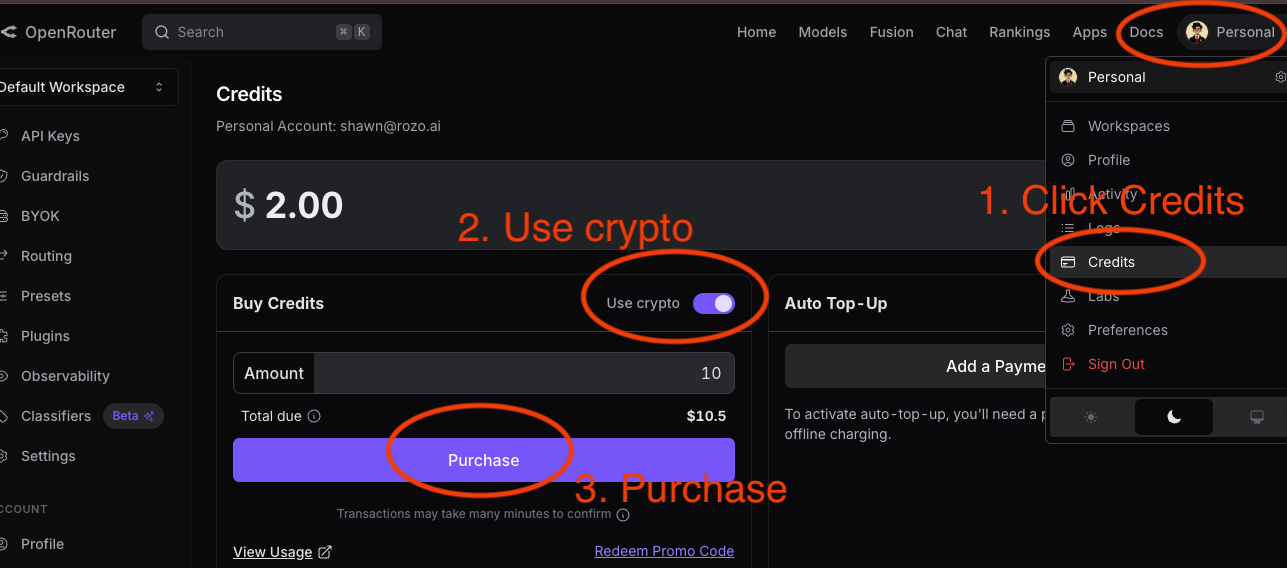
- Paste your OpenRouter payment link.
- Pay it from the wallet and chain you already hold.
- The payment settles to the merchant. Nothing is stored, nothing is issued, nothing is held.
The card route buys you one thing: a card works at merchants that only accept cards. If the merchant already exposes a payment link, as OpenRouter does, that middle step is doing no work for you and is adding two failure modes: the card can be declined, and the balance has to sit somewhere until you spend it.
Why "no KYC" means something different here
"No KYC" is usually a policy. Policies are set by a company and can be changed by that company, including retroactively, including at the exact moment you want your money back. If a service holds your funds and later decides it needs your identity documents, you find out that the earlier promise was a preference rather than a property.
Here it is not a policy. Identity verification exists so that a business that holds customer funds can know whose funds it holds. A checkout that never holds your funds has nothing to attach an identity to.
So there is no ROZO account to open, no email to verify, and no document to upload. Not because we decided to be relaxed about it, but because the payment goes from your wallet to the merchant and never becomes a balance we are responsible for.
No balance is held for you
This is the part worth being explicit about, because it is the difference that only shows up on a bad day.
ROZO Checkout is a payment surface. Your funds move from your wallet to the merchant's payment link. There is no stored balance, no wallet we control on your behalf, and no internal credit that has to be redeemed later.
What follows from that is simple: there is no account to suspend, no balance to freeze, and no refund queue to sit in. Not as a service commitment we are making to you, but as a consequence of not holding the money in the first place.
A custodial product cannot make that statement no matter how well it is run, because holding customer balances and being able to freeze customer balances are the same capability.
What you actually need
- Your OpenRouter payment link or payment ID.
- A wallet holding funds on a supported chain.
That is the whole list. Paste the link, pick the chain and token you already hold, confirm in your own wallet. The order is priced in USDC, so the dollar amount is fixed when the order is created and does not drift while you are paying.
End to end this normally takes about 30 to 90 seconds.
Which chain to pay from
Pay from what you already hold rather than moving funds around first. Every extra hop is another chance to send to the wrong place, and crypto payments do not have an undo button.
Smoothest for typical top-up sizes:
- Bitcoin over Lightning. Built for small, frequent payments, confirms in seconds.
- Solana. Confirms in seconds, network fee is a fraction of a cent.
- Base. Low fees, quick confirmation.
- BNB Chain. Widely held, low fees.
Ethereum mainnet is supported, and it is worth being honest about it: the network's own gas cost is high enough that on a typical $10 to $20 top-up it is disproportionate to the amount being moved. It makes sense for larger transfers and poor sense for small ones. That cost goes to the network, not to ROZO.
USDT is accepted as payment on the chains listed above.
What going cardless does not give you
Being straight about the tradeoffs, because a card genuinely does some things this does not:
- No card number to use elsewhere. This pays OpenRouter payment links. It does not give you a payment instrument for merchants that only take cards.
- No automatic recurring top-up. Auto top-up charges a stored instrument, and a self-custody wallet does not work that way. That tradeoff is covered in its own guide.
- No recovery of funds sent somewhere else. If you already sent a payment to the wrong chain or address, that is a recovery question and depends entirely on where it landed.