
This page walks the chain in order. First, how to read the error and identify who said no. Second, the fixes that work on the official path, because those are free and you should exhaust them before doing anything else. Third, the routes that skip cards entirely, including one this site operates, described honestly alongside the alternatives.
Verified on 10 August 2026. ROZO Checkout is an independent third-party checkout and is not affiliated with OpenRouter or Coinbase.
Who is actually declining your card
A card payment passes through at least four parties, and any one of them can stop it. Working out which one refused you is the difference between a fix that takes two minutes and an afternoon of pointless retries.
Your issuing bank is the most common source. It sees a cross-border charge from a payments processor to a merchant category it may not recognise, often for an unusual amount, and applies its own risk rules. This is the decline you can most often clear yourself, because banks give customers direct controls over it.
The card network and the card product are the second layer. Prepaid cards, virtual cards, and some debit products are simply not enabled for international or recurring merchant charges, regardless of your balance. Users on Latin American prepaid wallets have reported being refused consistently for weeks with no error on their side to fix, because there was nothing on their side to fix.
The payment processor's fraud filter is the third. It scores the transaction on signals you cannot see: the card's issuing country versus your connection's apparent country, how many attempts came from this account recently, whether the billing details match. A VPN that terminates in a different country than your bank card is a classic silent trigger here, and it can make a perfectly legitimate card look like it needs sanctions screening.
OpenRouter itself is the least likely party to be refusing you, which is why support tickets about declines often take a long time to produce a resolution. There is frequently nothing on the merchant side to change.
The practical consequence: read the wording. "Payment method not supported" points at the card product. "Declined by issuer" points at your bank. A generic "payment could not be processed" usually points at the fraud filter.
Stop retrying, and why that is not just advice
The instinct after a refused charge is to press the button again. That instinct is actively harmful here, and it is worth understanding the mechanism rather than just taking the rule on faith.
Repeated failed authorisations on the same card, at the same merchant, in a short window, is the exact fingerprint of card testing, where someone with a stolen card number probes it with small charges to see if it is live. Fraud systems are built to catch that fingerprint, and they cannot tell your frustration apart from an attack. So each retry raises your risk score, which makes the next attempt more likely to fail, which invites another retry. People have burned six hours cycling through several cards this way while a production system sat idle, and finished with more cards blocked than they started with.
Banks add a second trap on top. Many issuers apply a velocity limit on top-ups to the same merchant, and users have hit an explicit "too many top-ups" wall after a handful of attempts in one day. Once that limit trips, the card is out of play for a cooling-off period no matter what else you fix, and the limit often applies per bank rather than per card, so switching to a second card from the same issuer changes nothing.
The rule that follows is narrow and worth obeying literally:
- One retry is reasonable, because transient network and 3-D Secure failures are real.
- A second failure means stop and diagnose. Do not attempt a third charge on that card today.
- Do not cycle through several cards in one session. That looks worse to a fraud filter than repeating one card, not better.
- If you have already tried many times, wait until the next day before attempting anything, even after you have fixed the underlying cause.
The official path: what to fix before anything else
These are free, they take minutes, and they resolve a real share of declines. Work them in order and stop as soon as one succeeds.
- Call your bank or open its app, and look for international transactions and online purchases in the card controls. Many banks ship these switched off by default on newer cards, and many will not send you any notification when they block the charge. Ask specifically whether a charge to this merchant was declined and for the reason code. Reading the bank's own reason is the single highest-value step on this page, because it converts guesswork into a known cause.
- Check the billing address you entered against exactly what your bank holds on file. Address verification compares strings, not meaning. An abbreviated street type, a missing apartment number, or a postcode formatted for a different country is enough to fail. Copy it character for character from your statement.
- Turn off your VPN and proxy before paying. If your connection appears to originate from a country under sanctions screening while your card was issued somewhere else, the mismatch alone can produce a refusal that no amount of card-swapping will clear. This has stranded users whose actual country was perfectly acceptable.
- Try a different card product, not just a different card. If the refused card was prepaid or virtual, the useful test is a full credit card from a different bank. Two prepaid cards will usually fail for the same reason.
- Try a wallet route if your bank supports it, such as a card loaded into a phone wallet, which can carry stronger authentication and sometimes clears where the raw card number does not.
- If all of that fails, open a support ticket with OpenRouter and include the exact error text, the approximate time, the last four digits, and the issuing country. Set expectations honestly, though: decline tickets often move slowly, because the merchant frequently cannot see or change what your bank decided.
When the card path is closed for structural reasons
For some people none of the above will ever work, and it is worth recognising that early rather than spending a week on it.
If you live somewhere local issuers do not enable cross-border digital services, if the only payment instrument you hold is a prepaid wallet card that the processor's rules exclude, if your country sits inside a sanctions screening perimeter regardless of your personal status, or if you simply have no credit card at all and only a domestic mobile money account, then the card path is not failing intermittently. It is closed. Users in this position have described weeks of refusals with no error message that pointed at anything they could change, and support replies that could not change it either.
The honest read is that in those cases the question stops being how to make the card work and becomes which non-card route to use. There are several, and they are genuinely different from one another:
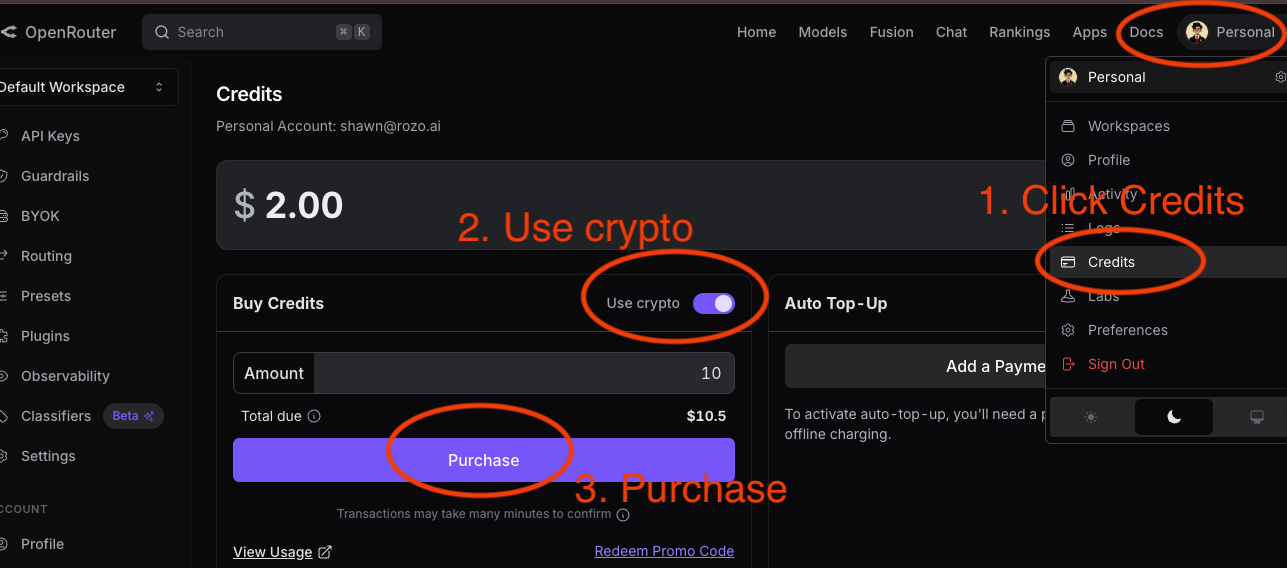
- OpenRouter's own crypto path. This is the first thing to try, because it is the official route and keeps you inside one system with one support channel. It charges 5% and works through a hosted crypto checkout. The caveat worth knowing before you send anything is that it accepts specific assets on specific chains only, and a payment made on the wrong chain does not bounce back, it simply sits there.
- A third-party crypto checkout, including this one. Covered in the next section.
- Borrowing a card from someone you trust. Unglamorous, but for a one-off top-up it is often the fastest path, provided the billing details entered match that person's bank records rather than yours.
- Waiting for the merchant to add your preferred method. People regularly ask for wallet-based options in the community. This is a real answer if you are not blocked today, and no answer at all if you are.
One cost note that matters when comparing: OpenRouter charges 5.5% with a minimum of $0.80 on card and AliPay payments, and 5% on its own crypto path. On a small top-up that minimum is the dominant fee, which is why very small card top-ups feel disproportionately expensive.
The crypto route, described plainly
If you already hold crypto, this route removes the entire class of problem described above. There is no issuer to refuse the charge, no billing address to verify, no country-of-connection mismatch, and no retry counter working against you. If you do not already hold crypto, be realistic: acquiring it usually means an exchange, which usually means a card or bank transfer and identity verification, so it may reintroduce the same obstacle in a different place. This route is strongest for people who are already holding.
ROZO Checkout works by taking an OpenRouter payment link or payment ID, letting you pay with the asset and chain you already have, and settling to the merchant in what the merchant expects. You paste the link, choose your token and chain, and confirm in your own wallet. It usually takes under two minutes. There is no account to create and no balance held on your behalf, which also means there is no stored value that could later become unreachable.
Being straight about the trade-offs, since a page that only lists advantages is not useful:
- Crypto payments are irreversible. If something goes wrong there is no chargeback, which is a real protection you give up relative to a card.
- You are adding a third party to the transaction. That is a judgement call you should make deliberately rather than because a blog told you to.
- Network fees still apply and vary by chain. On a small top-up, paying from a low-fee chain matters more than anything else about the route.
- ROZO charges a 1% service fee, shown before you pay. That is a present-tense statement about an early-stage service, not a permanent promise, and you should check the current terms rather than trusting this sentence in six months.
If OpenRouter's own crypto path works for you, there is no strong reason to leave it. The third-party route earns its place when you need an asset or a chain the official checkout does not take.
A decision path you can follow in ten minutes
Putting the whole page into one sequence, so you can work top to bottom without re-reading anything.
- Read the exact error text and note it down. "Payment method not supported" and "declined by issuer" send you to different places, and a generic processing error means the fraud filter most likely spoke.
- Stop paying. If you have already made two or more attempts today, make no further attempts on any card until tomorrow, regardless of what you fix in the meantime. Continuing past this step is what turns a recoverable situation into a locked one.
- Contact your bank and ask for the decline reason code, and while you are there enable international and online purchases. This is the step most people skip and the one most likely to end the problem.
- Fix the mechanical causes: exact billing address, VPN off, correct card country. Re-attempt once, the next day, after these are corrected.
- If it fails again, switch card class rather than card. A credit card from a different issuer is a real test. A second prepaid card is not.
- If you are structurally blocked, choose a non-card route. Try OpenRouter's official crypto path first, since it keeps everything in one system. If your asset or chain is not supported there, a third-party checkout such as this one covers the gap.
- Open a support ticket in parallel rather than instead. It costs nothing, it may surface a merchant-side cause, and it builds the record if the problem is regional and persistent.
One thing to be clear about at the end: if money has already left your account and no credits appeared, that is a different problem from a decline, and it needs a different page. A decline means no money moved. Confirm which one you are actually looking at before troubleshooting, because the fixes do not overlap.