
What follows is a decision tree, not a sales page. It starts with the official options, because those are the cheapest and the least surprising, and only reaches alternatives once the official ones are genuinely closed to you. It also explains why some blocks cannot be argued with, and why one common workaround makes things worse.
Verified on 10 August 2026.
First, work out which of the four blocks you actually have
These look identical from the checkout page and have completely different fixes. Read the exact wording of the error before doing anything else.
- A soft decline. The charge was attempted and your bank refused it. Wording usually mentions the card being declined or the payment failing. Your bank app may show the attempt. This is often fixable with the bank.
- A payment method not supported message. The charge was never attempted. The processor looked at your card type or issuing country and declined to route it. Common with domestic-only debit schemes and some prepaid products. Arguing with your bank will not help, because your bank never saw it.
- A region or compliance block. The account or the payment is refused on the basis of where it appears to originate. Wording is vaguer, may reference terms of service or unsupported region, and can also show up as the checkout refusing to let you add or update a payment method at all. Retrying more often makes this worse, not better.
- No instrument at all. Nothing is broken. You have money, but it lives in a local mobile wallet, a bank account without an international card, or cash, and the checkout has no field that accepts it.
Blocks one and two are covered in depth in our guide on OpenRouter payment declines. Blocks three and four are the subject of the rest of this page.
If you cannot tell which one you have, the useful test is whether the money left your account. A pending or reversed authorisation means an attempt was made. No trace at all in your bank app means the attempt never reached your bank.
Try the official paths before anything else
The plainest route is almost always the right first move, and the two official routes are different products with different failure modes. It is worth trying both before concluding you are locked out.
- The card and AliPay path. OpenRouter charges 5.5% with a minimum of $0.80 on this route. If your first card was refused, a card from a different issuer, or from a different scheme, is often the whole fix. Domestic-only debit schemes and prepaid products fail far more often than a mainstream international credit card from the same bank.
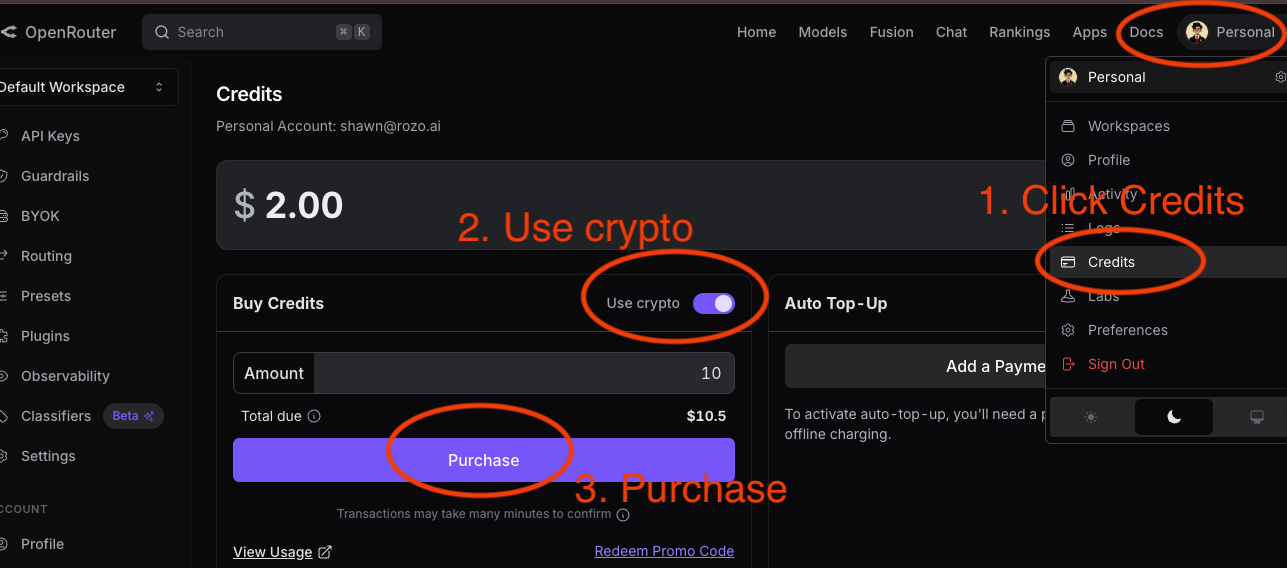
- OpenRouter's own crypto path, which charges 5%. This bypasses card rails entirely, so a card that is not supported in your country is not relevant to it. It has its own constraints: it accepts specific tokens on specific chains, and sending a token or a chain it does not expect is the single most common way people end up with a payment that settled on-chain but never became credits. If you go this way, follow the accepted network and token exactly as shown on the checkout, and read our guide on crypto payments that were not credited before you send.
- Contact OpenRouter support if the block is on your account rather than your card. Only OpenRouter can change a decision OpenRouter made. No third party, including us, can lift a restriction on your OpenRouter account, and anyone claiming otherwise is not being straight with you.
If one of these works, stop here. You do not need a workaround.
If a compliance or sanctions screen is what stopped you
This is the case people most want a clever answer to, and it is the case where a clever answer is most likely to hurt them.
Payment processors and the platforms they serve run their own compliance and sanctions screening. They are legally obliged to, and the screening is based on signals they collect rather than on what you tell them: the issuing country of your card, the billing address on file, the country your connection appears to originate from, and the results of whatever list checks their provider runs. Those signals do not always agree with each other, and when they disagree the system fails closed.
That produces a specific and very common trap. Using a VPN can itself cause the block. If your connection appears to come from one country while your card was issued in another, that mismatch is exactly the pattern screening systems are built to flag, and the resulting restriction can persist after the VPN is switched off because it is now attached to the account or the billing profile rather than to the session. People routinely arrive at a hard block having created it themselves while trying to avoid a soft one.
The honest guidance is narrow. Do not use a VPN, a proxy, or a false billing address to make your payment appear to originate somewhere it does not. That is an attempt to defeat a control, it is against the terms of the services involved, and it can cost you the account and the balance in it. If the mismatch was accidental, say so plainly to OpenRouter support and ask for your billing country to be corrected to your actual country of residence.
And the hard part: if your country of residence is genuinely outside what a provider is permitted to serve, no payment method changes that. Choosing a different rail does not change who you are or where you are, and this page is not legal advice about your situation.
If you have money but no card at all
This is a much larger population than the checkout designs of most Western SaaS products assume. Across large parts of South and Southeast Asia, Africa, and Latin America, the mainstream way to hold and move money is a mobile wallet or a bank transfer scheme, not a card. People in this position have a working, regulated, entirely legitimate way to pay for things, and the checkout simply has no field for it.
What we see people try, and how each actually behaves:
- A friend or colleague pays with their card. Genuinely works, and is the simplest answer if you have someone willing. The limit is social, not technical.
- A local mobile wallet used directly. Usually not possible, because these schemes are domestic and the merchant has to integrate each one. Worth checking whether your wallet issues a linked international card, which some do.
- Cash-to-crypto through a local peer-to-peer market. Widely used where cards are scarce. Understand that you take on counterparty risk with whoever you trade with, and that these markets vary enormously in quality by region.
- Asking the provider to add PayPal or another local method. Reasonable to ask, and people do ask regularly. Treat it as a request with an unknown timeline rather than a plan for today.
Once funds are in a self-custody wallet, the card question stops applying: both OpenRouter's own crypto path and independent checkouts accept payment from a wallet, and neither cares what your bank does or does not issue.
Do crypto-funded virtual cards work?
This comes up constantly, so here is the mechanism rather than a yes or no.
A crypto-funded virtual card takes your crypto, holds it as a balance with the card issuer, and gives you a card number drawn on that balance. When you pay OpenRouter with it, the charge travels the ordinary card rails.
Which means it inherits everything about card rails. It can be declined. Its BIN, the leading digits that identify the issuer and product type, tells the processor it is prepaid and often which country it was issued from, and some merchants and risk systems treat prepaid BINs more suspiciously than normal credit cards. Some of these products are issued in one country while you live in another, which recreates the exact country mismatch described above. And the issuer holds your balance, so a suspended card account means suspended funds and a support queue in front of them.
So the answer is: sometimes, and the failure mode is the same one you were trying to escape. A virtual card is genuinely useful when the merchant only accepts cards, because then a card is the only shape that fits. OpenRouter is not that merchant. It exposes a payment link and accepts crypto directly, so putting a card in the middle adds a decline risk and a held balance in exchange for nothing.
We wrote about that comparison in more detail in our guide to paying OpenRouter without a card, which covers the cardless mechanism itself. This page is about deciding whether you are in that situation at all.
Where an independent checkout fits, and where it does not
ROZO Checkout is one option among several, and it is worth being precise about which problem it solves.
What it does: you paste your OpenRouter payment link, pay it from the chain and token you already hold, and the payment settles to the merchant. It is useful specifically when OpenRouter's own crypto path is awkward for you, because the token or chain you hold is not one it accepts, or because you want to pay over Lightning. We charge a 1% service fee, shown before you pay, against 5.5% with a $0.80 minimum on the card and AliPay route and 5% on OpenRouter's own crypto route. Network fees still apply and go to the network, not to us. ROZO is an independent third party and is not affiliated with OpenRouter or Coinbase.
What it does not do, stated plainly so you do not waste your time:
- It does not lift a restriction on your OpenRouter account. If OpenRouter has blocked your account, paying through us changes nothing.
- It does not make a provider able to serve a region it is not permitted to serve.
- It is not a way around compliance screening, and we would not help you build one.
- It does not turn a local mobile wallet balance into a payment by itself. You need funds in a wallet you control first, and how you get there is a local question we cannot answer for you.
If your block is a card problem and you hold crypto, this is a short path. If your block is an account or jurisdiction problem, the honest answer is that the fix is with OpenRouter, not with any payment provider.