
That is a lot of setup for a small top-up, and for many people an ordinary exchange withdrawal is enough instead. The table below gives the network to pick on Binance, Bybit, OKX and Bitget, with a link to the step by step guide for each. The rest of this article covers the generic workflow for any exchange: how the withdrawal step works, how to pick the network, and where exchanges add conditions of their own.
Which network to pick on each exchange
| Exchange | Network to pick for USDT | USDT withdrawal fee | Step by step guide |
|---|---|---|---|
| Binance | BNB Smart Chain (BEP20) | 0.01 USDT | Pay OpenRouter with Binance (USDT on BNB Chain) |
| Bybit | Polygon, or Solana | Shown in Bybit's withdrawal window | Pay OpenRouter with Bybit USDT (Polygon, Solana, Ethereum) |
| OKX | Polygon (USDT0), or Solana | 0.0085 USDT on Polygon, 0.29 USDT on Solana | Pay OpenRouter with OKX USDT (Polygon, Solana, Ethereum) |
| Bitget | Solana, or BNB Chain (BEP20) | 0.5 USDT on Solana, 0.01 USDT on BNB Chain | Pay OpenRouter with USDT from Bitget on Solana |
| Any other exchange | BNB Chain, Solana or Polygon, whichever it lists | Shown on the exchange's withdrawal screen | The steps below |
Fees are as listed on Binance's and OKX's withdrawal fee pages and in Bitget's public coin list on 20 October 2026. Bybit shows its fee for each chain in the withdrawal window. Fees and network lists change, so check the withdrawal screen before you confirm. ROZO does not accept Tron (TRC20) from any exchange. ROZO is independent and is not affiliated with any of these exchanges.
Why the crypto option asks for a wallet
At the time of writing, OpenRouter's crypto checkout hands you a Coinbase-hosted payment link, and that link is narrow: it accepts USDC on Base. Not USDT, not USDC on Ethereum, not USDC on Solana. One token, one chain. Check the current payment page before you rely on that, because payment methods change.
If your exchange balance is already USDC and your exchange offers Base withdrawals, you can pay it directly. Otherwise you are holding a token or a chain the link will not take, and the usual advice is to route around it: install a wallet, move funds there, bridge to Base, keep a little ETH for gas, then finally pay.
Each extra step adds somewhere to go wrong: the wrong network on a withdrawal, an unfamiliar bridge, a seed phrase you now have to keep. For a one-off credit purchase that is more overhead than the amount warrants.
What does not solve it
- Waiting for OpenRouter to accept your token. The restriction comes from the payment link itself, not from a setting you can change.
- Trading into USDC on Base inside the exchange. That only helps if your exchange offers Base as a withdrawal network, which not every exchange does: check its withdrawal network list first.
- Using the card instead. If cards worked for you, you would not be reading this; our post on a card declined when the bank shows nothing covers that case.
- Installing a wallet purely as a waypoint. It works, but you are now responsible for a seed phrase forever in exchange for one transfer.
What does solve it: change the coin the link accepts
The blocker is a mismatch between what you hold and what the link accepts. Close that gap and, for many exchanges, the wallet question goes away: you withdraw to an external address the same way you would send to anyone else.
That is the idea behind ROZO Checkout. You paste the OpenRouter link, say which coin you actually have, and get a one-time deposit address for that coin on that chain. A funder wallet then settles the checkout invoice, and your OpenRouter credits appear after that payment settles on chain.
One caveat worth knowing before you start: not every exchange will withdraw to any address you type in. Some restrict withdrawals to addresses you have verified as your own, some ask for beneficiary or travel-rule information for external transfers, and some hold new withdrawal addresses for a review period. If your exchange does that, the workaround is to withdraw to a wallet you control first and send the deposit from there, or to use an exchange or account tier that permits external withdrawals.
The route, step by step
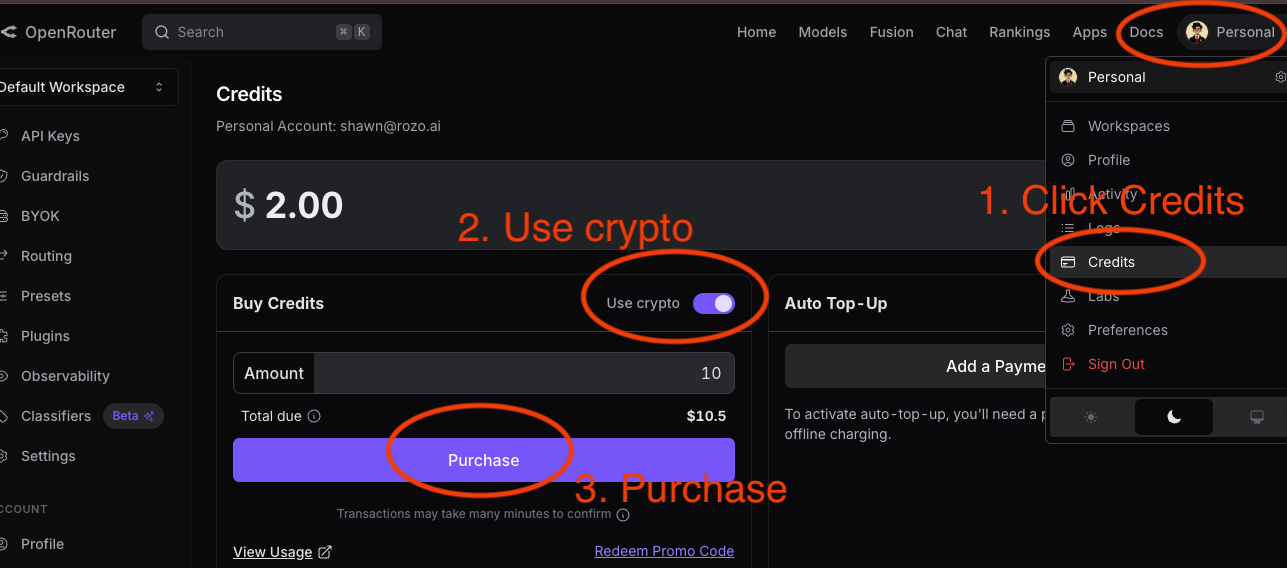
- In OpenRouter, open Settings then Credits, turn on the crypto option, enter the amount and click Purchase, as the dashboard is laid out at the time of writing. Copy the payment link it produces.
- Paste the link at checkout.rozo.ai.
- Pick the coin and chain you already hold on the exchange: USDT or USDC on Solana, BNB Chain, Ethereum, Polygon or Arbitrum; USDC on Base or Stellar; or Bitcoin over Lightning.
- ROZO shows a quoted amount and a one-time deposit address. Copy both.
- In your exchange, open the withdrawal screen for that token, choose the same network, paste the address, and send the quoted amount. Check the network selector against the ROZO page before you confirm: a mismatched network may be unrecoverable. If your exchange asks who owns the address, or blocks the withdrawal, see the caveat above.
- Once the transfer lands, ROZO settles the OpenRouter link. Credits are applied after the payment settles on chain; the ROZO payment page shows live status until it does.
There is no ROZO account, no browser extension and no KYC form on our side. Whatever identity checks your exchange applies to a withdrawal still apply there.
One thing to note about the token names. Native coins work as well as stablecoins: you can withdraw ETH on Ethereum, Base or Arbitrum, BNB on BNB Chain, SOL on Solana and POL on Polygon, as long as you pick that same coin and network on the ROZO page. A native coin order carries the 1% service fee plus an FX spread on the coin price, built into the coin amount. If your exchange balance is in POL, withdraw it on Polygon and choose POL on the ROZO page.
On price: the ROZO payment page shows the exact amount and network to send, and you should send exactly what it shows. OpenRouter's own crypto fee, around 5% as listed on OpenRouter's FAQ at the time of writing, is already baked into the link. ROZO charges a 1% service fee, shown before you send anything. Your exchange will charge its own withdrawal fee, which varies by chain and is worth checking before you pick one.