
If you are seeing a card decline, retrying is usually the worst thing you can do, and this page explains why. If you are seeing "insufficient funds" while your wallet plainly shows a balance, the amount is not the problem and adding more money will not help.
This page maps each symptom to what is actually happening, then covers the route that avoids both failure modes: paying from the asset and chain you already hold. ROZO Checkout is an independent third-party checkout. It is not affiliated with OpenRouter or Coinbase.
Why cards get declined on OpenRouter
A decline is a decision made by your bank or by a risk filter somewhere in the payment chain, not by OpenRouter refusing your business. Three causes account for most of them:
- The card's BIN is filtered. The first digits of your card identify the issuing bank and country. Cross-border charges to AI and developer services are a category some issuers screen hard, and prepaid or virtual card ranges get screened even harder.
- The billing address does not match. Address verification compares what you typed against what your bank holds on file. A moved address, an abbreviated street, or a postcode formatted for a different country is enough to fail the check.
- Repeated attempts look like card testing. Several failed charges on the same card in a short window is the exact pattern fraud systems are built to catch. Each retry makes the next one more likely to fail.
That last one matters most in practice. The instinct after a decline is to try again immediately, and that instinct is what turns one refused charge into a card that will not go through at all for the rest of the day. If a charge is refused twice, stop and use a different route rather than a third attempt.
"Insufficient funds" when your wallet clearly has a balance
This is the error that confuses people the most, because it appears to be false. Your wallet shows USDC. The checkout says you do not have enough. Both are true at the same time.
OpenRouter's balance is denominated in USDC, and its checkout reads that USDC on one specific chain. Stablecoins are chain-specific: USDC on Solana, USDC on Base, and USDC on Ethereum are separate balances that happen to share a name. If your USDC is sitting somewhere the checkout does not read, it is invisible to that checkout, and the page reports insufficient funds even though the money is real and yours.
The same applies to holding the wrong asset entirely. Bitcoin, SOL, or USDT are not USDC, so the native path is closed until you convert.
There is a sharper edge to this worth stating plainly: crypto payments are not reversible. Sending funds to an address on a chain the recipient does not read has no undo button. This is the one failure mode where guessing is expensive, so it is worth being certain about the chain before confirming anything.
Quick diagnosis: symptom to cause
- "Card declined" or "payment could not be processed": your issuer or a risk filter refused it. Do not retry more than once. See the card section above.
- "Insufficient funds" with a visibly funded wallet: right asset, wrong chain. Adding more money will not fix it.
- Wallet shows the transaction succeeded but credits never appeared: the funds moved, but not to a place the checkout reads. This is a recovery question, not a payment question.
- The payment page expires before you finish: payment links are time-bound. Start a fresh one rather than paying an expired link.
- Everything looks fine but the balance is still zero: check whether the top-up was completed on OpenRouter's side at all, before assuming the payment failed.
Topping up without a card at all
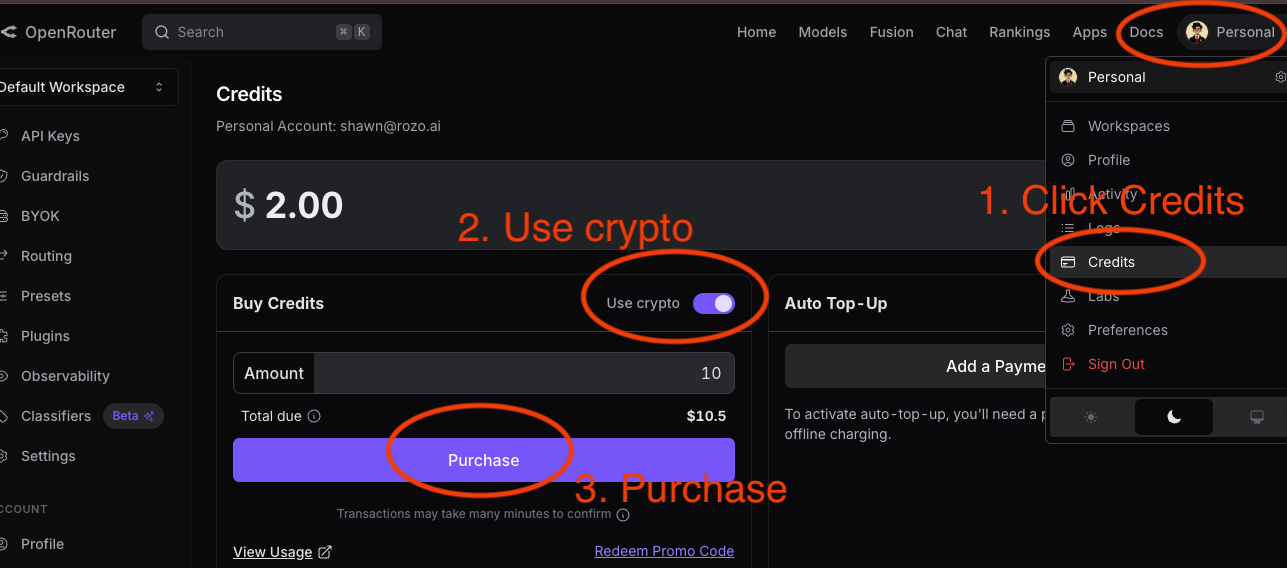
If your money is already in crypto, the card problem is avoidable rather than solvable. There is no issuer to refuse the charge, no billing address to verify, and no retry counter working against you.
The flow is short:
- Copy your OpenRouter payment link or payment ID.
- Paste it into ROZO Checkout.
- Pick the chain and token you already hold.
- Confirm in your own wallet.
The order is priced in USDC, so the dollar amount is fixed when the order is created and does not move while you are paying. Settlement to USDC is handled for you, which is the part that removes the wrong-chain trap: you are not asked to get the right stablecoin onto the right chain yourself.
End to end this normally takes about 30 to 90 seconds. There is no ROZO account to create, no email to verify, and no KYC form in the way. ROZO does not hold a balance for you.
Which chain to pay from
Pay from whatever you already hold rather than moving funds around first. Every extra hop is another chance to send to the wrong place.
In practice these are the smoothest for typical top-up sizes:
- Bitcoin over Lightning. Built for small, frequent payments, and confirms in seconds.
- Solana. Confirms in seconds, network fee is a fraction of a cent.
- Base. Low fees, quick confirmation.
- BNB Chain. Widely held, low fees.
Ethereum mainnet is supported, but it is worth being honest about it: the network's own gas cost is high enough that on a typical $10 to $20 top-up it is disproportionate to the amount being moved. It makes sense for larger transfers and poor sense for small ones. That fee goes to the network, not to ROZO.
USDT is accepted as payment on the chains listed above.
One thing that cannot go wrong here
Worth saying while we are on the subject of payments failing, because it is the failure people ask about most once they have been burned.
ROZO Checkout does not hold a balance for you. Your funds move from your wallet to the merchant's payment link. There is no stored credit, no account, and no wallet we control on your behalf.
So the failure mode where a balance sits somewhere and later becomes unreachable does not exist on this route. Not as a promise we are making, but because holding customer funds and being able to freeze customer funds are the same capability, and we do not have it.
What this does not fix
Being straight about the limits, because the wrong expectation here costs real money:
- Funds you have already sent to the wrong chain or the wrong address are not something a checkout can pull back. That is a recovery problem and depends entirely on where the money landed.
- Anything that is wrong on your OpenRouter account itself, including a top-up recorded on their side, has to be resolved with OpenRouter's own support.
- A payment link that has already been used or has expired cannot be revived. Start a new one.
If you have already sent a payment somewhere it should not have gone, the ROZO Help guides cover the common cases and what is realistically recoverable in each.