
ROZO accepts both USDT and USDC on Arbitrum. Paste your OpenRouter payment link into ROZO Checkout and start the payment. On the ROZO payment page, choose Arbitrum and your token, and ROZO shows a one-time deposit address with the exact amount. When your transfer confirms, ROZO pays the OpenRouter invoice for you.
Before you start: which tokens on Arbitrum
ROZO accepts USDT (USDT0 on Arbitrum) and USDC on Arbitrum One. Exchanges list that USDT as USDT on the Arbitrum One network.
For USDC, use plain USDC on Arbitrum One. Some exchanges also list a separate bridged USDC (USDC.e) on Arbitrum. That is a different token, and it is not the one ROZO asks for.
You do not pick Arbitrum on the checkout.rozo.ai home page. You pick it on the ROZO payment page that opens after you start the payment, as the steps below show.
Step by step: Arbitrum to OpenRouter credits
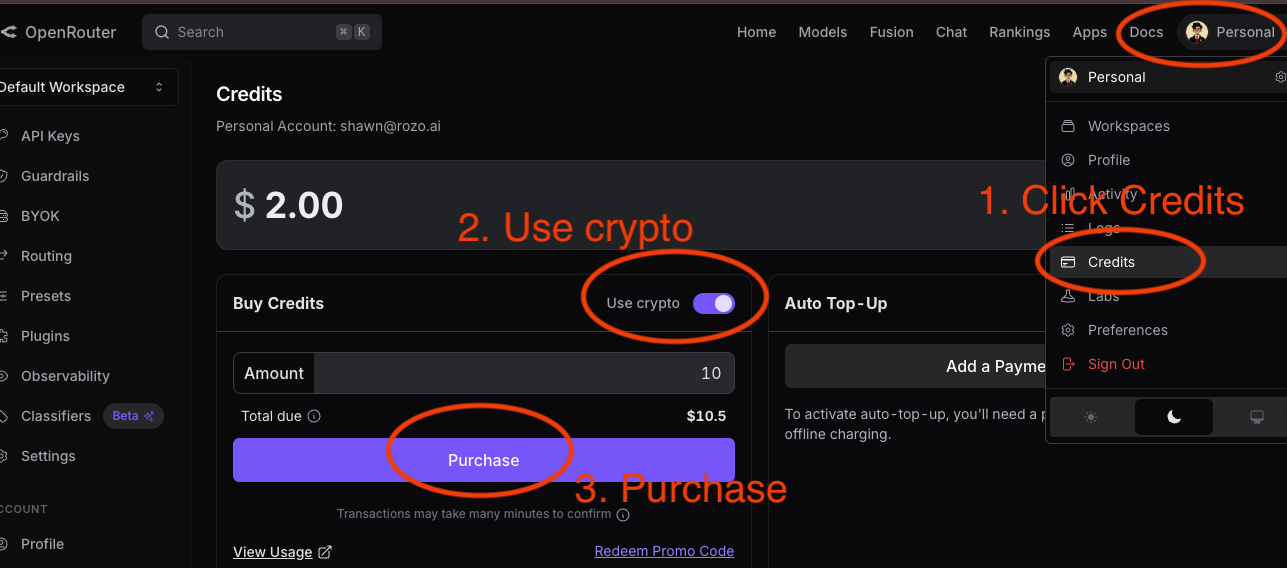
- In OpenRouter, open Settings then Credits, turn on the crypto option, enter the amount and click Purchase. Copy the payment link it generates.
- Open checkout.rozo.ai, paste the link and start the payment. ROZO shows the quote; confirm it with Yes, pay with USDC/USDT.
- The ROZO payment page opens with its payment window. Choose Pay to address, then pick USDT on Arbitrum or USDC on Arbitrum, whichever you hold. If you close the window, the pay button on the page opens it again.
- The page shows a one-time deposit address and the exact amount to send. In your exchange or wallet, send that token to the address and select Arbitrum One as the network.
- Check that the amount that arrives equals the amount shown, then confirm. Once the transfer confirms on chain, ROZO settles the OpenRouter link and the credits appear on your account.
Paying from an exchange or a wallet
Binance lists Arbitrum One for both USDT and USDC withdrawals. OKX does too, and labels its USDT network Arbitrum One (USDT0). Bitget's public coin list also shows Arbitrum One for both tokens; check that its withdrawals are open before you start. On any other exchange, check your exchange's withdrawal network list for Arbitrum One.
An exchange charges its own withdrawal fee and shows it before you confirm. If that fee comes out of the amount you type, add it on top so the full amount arrives.
From a self-custody wallet such as MetaMask, keep a little ETH on Arbitrum One, because Arbitrum network fees are paid in ETH. If you would rather connect the wallet, choose Pay with wallet in the same payment window and pick your Arbitrum balance if it is listed.
Three mistakes that cost money
Wrong network: USDT or USDC sent on Ethereum, BNB Chain or any other network to an address that expects Arbitrum One cannot settle the payment. EVM addresses look the same on every network, so check the network selector, not just the address.
Wrong token: the token you send must match the option you picked. USDC sent to a USDT on Arbitrum order, or bridged USDC.e instead of USDC, does not match.
Wrong amount or late send: send the exact amount the payment page shows, before the quote expires. A one-time deposit address belongs to one quote. Never reuse an address from an earlier attempt.
What it costs
Each cost is shown before you pay:
- ROZO charges a 1% service fee, shown before you send anything.
- OpenRouter's own crypto fee is already inside the payment link amount.
- Your exchange or wallet charges the Arbitrum network or withdrawal fee, shown before you confirm. It does not go to ROZO.
OpenRouter's crypto checkout has a $10 minimum. If you only want $5 of credits, OpenRouter's Stripe form has a Crypto method that accepts $5, and ROZO can pay that crypto.stripe.com link too.
ROZO is independent and is not affiliated with OpenRouter, Coinbase, Arbitrum, Tether or Circle. There is no ROZO account, no card and no KYC form on our side. Whatever checks your exchange applies to withdrawals still apply.