
ROZO Checkout pays that same OpenRouter payment link with native ETH on Ethereum, Base or Arbitrum. You paste the link, pick ETH and the network, and send the exact amount shown to a one-time deposit address. ROZO settles the Coinbase invoice in USDC for you, so there is no swap step and no ROZO account.
ROZO Checkout is independent and not affiliated with OpenRouter or Coinbase.
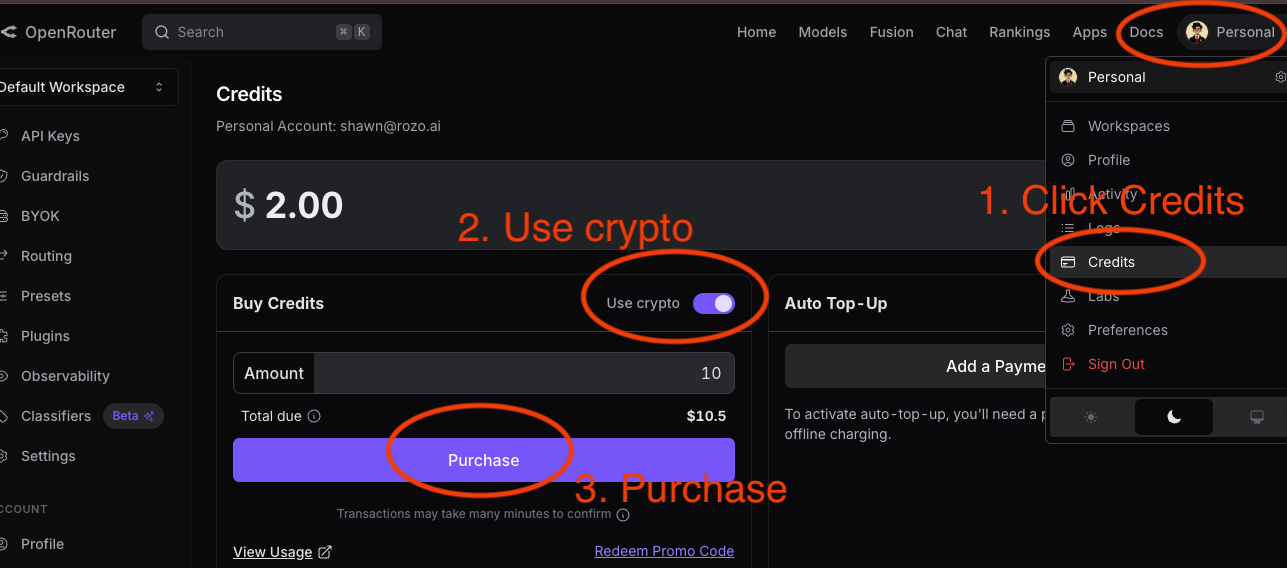
Pay with ETH in 4 steps
- In OpenRouter, open Settings, then Credits. Turn on the crypto option, enter the amount ($10 or more) and click Purchase. Copy the payment link it produces.
- Paste the link at checkout.rozo.ai and choose ETH on the network you hold it on: Ethereum, Base or Arbitrum.
- The page shows a one-time deposit address, a QR code and the exact ETH amount. Scan the QR code with your wallet, or copy the address and amount, and send exactly that amount on that network.
- The page watches for the transfer and shows live status. Once your ETH arrives, the OpenRouter invoice is settled and the credits are applied.
Which network to send ETH on
Pick the network your ETH already sits on. Moving it to another network first costs a bridge fee and time for no benefit.
- Base: low gas, and the cheapest way to send ETH for a typical $10 to $20 top-up.
- Arbitrum: low gas as well, a good fit if your ETH is already there.
- Ethereum mainnet: supported, but its gas is disproportionate on a small top-up. Keep it for larger amounts.
Whichever you choose, send on exactly the network shown on the payment page. ETH sent on any other network will not arrive at the deposit address. Keep a little extra ETH in the wallet for gas too: the order amount has to arrive in full, and the network fee comes on top.
What it costs
A native ETH order carries ROZO's 1% service fee plus an FX spread on the ETH price. Both are built into the ETH amount, and the page shows your rate with the fee included before you send. OpenRouter's own 5% crypto fee is already inside the link amount, and the $10 crypto minimum set on the link still applies.
Gas goes to the network, not to ROZO or OpenRouter. On Base and Arbitrum it is small; on Ethereum mainnet it can be a noticeable share of a small payment.
If you would rather avoid the FX spread, stablecoins are priced without one: USDC on Base, or USDC or USDT on Arbitrum or Ethereum. Our Arbitrum guide covers that route.
Sending from an exchange
You can send straight from an exchange withdrawal, as long as the exchange lets you withdraw ETH on the network shown on the payment page.
Make sure the amount that arrives is at least the amount shown. Exchange withdrawal fees are not covered, and many exchanges take their fee out of the amount you type in. Some exchanges only release withdrawals to addresses you have verified; if yours does, withdraw to your own wallet first and send from there.
Before you send
- One payment link can only be paid one way. Once you continue with ETH, that link cannot also be paid with USDC, USDT or Bitcoin.
- For a very large payment, use USDC or USDT instead. Native coins are only offered up to a per-order limit, so above it the ETH option does not appear.
- If less ETH arrives than the order amount, the page shows how much is missing.
- If your wallet shows the transfer as confirmed and the page is still waiting, do not pay a second time. Keep the transaction hash and contact support.
- Crypto payments to OpenRouter are never refundable under OpenRouter's policy. If something goes wrong with the ROZO order itself, contact us: we ask you for a refund address and never send refunds back to an exchange automatically.