
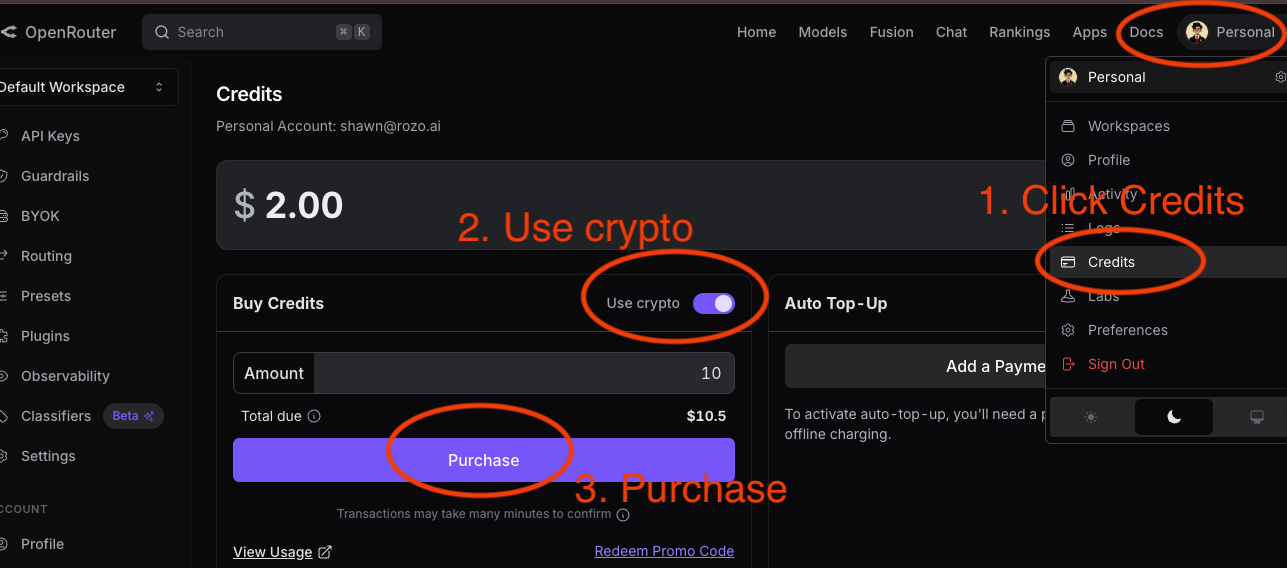
OpenRouter's published fees are 5.5% with a $0.80 minimum on card and AliPay purchases, and 5% on crypto. Those two numbers are the entire native menu. Everything else you might read about — crypto debit cards, off-ramping to a bank, prepaid virtual cards — is a way of arriving at one of those two doors, usually with another fee stacked in front of it.
This page does the arithmetic on all of them, including the third-party route this site exists to offer. Where a number comes from OpenRouter, it is OpenRouter's published figure. Where it is ours, it is stated plainly as ours.
Fees verified against OpenRouter's published documentation on 4 August 2026. Providers change pricing without notice, so check the source before relying on a figure here for a large purchase; the date above the article tells you when this page was last re-checked.
What OpenRouter charges to buy credits
Two published rates, and one detail that catches people out.
Card or AliPay: 5.5%, with a $0.80 minimum fee. Crypto (USDC): 5%.
The minimum is the part worth understanding before you top up. A $5 purchase on a card pays the $0.80 floor rather than 5.5% of $5, which works out to roughly 16% — more than three times the headline rate. A $100 purchase pays $5.50, the true 5.5%. The rate you actually pay on a card is only the advertised rate once the purchase is large enough for the percentage to exceed the floor.
The crypto rate has no equivalent floor, which is why small crypto top-ups are proportionally much cheaper than small card top-ups.
One more line item exists but does not apply at purchase time: bring-your-own-key usage draws a surcharge against your credit balance during usage, not when you buy the credits. It is a usage cost, not a funding cost, so it sits outside this comparison.
The three ways to fund credits
Strip away the marketing and there are three shapes.
- Pay OpenRouter's card rail. Any Visa or Mastercard, including a crypto-funded one. You pay 5.5%.
- Pay OpenRouter's crypto rail. USDC on the chain its checkout settles on. You pay 5%.
- Pay through a third-party checkout. Someone else pays OpenRouter on your behalf, and you pay them in whatever asset you actually hold.
A crypto debit card is not a fourth shape. It is shape one with a top-up fee in front of it: you load the card from your wallet, the card provider takes a cut of the load, and then OpenRouter takes 5.5% of the purchase. Two fees, sequentially, on the same money.
Off-ramping to a bank first is also shape one, with the exchange's withdrawal fee, one to five business days, and a taxable disposal in most jurisdictions standing in for the card provider's cut.
What a $100 top-up actually costs
Each line assumes you want $100 of usable credits and shows what leaves your wallet.
OpenRouter crypto (USDC): $105.00. OpenRouter card, no provider top-up fee: $105.50. OpenRouter card, via a crypto card charging 1% to load: about $106.55, plus whatever the card cost to issue. OpenRouter card, via a crypto card charging 5% to load: about $110.78, plus issuance. ROZO Checkout: $100.00 of credits for $100 plus the 1% service fee, plus the blockchain's own network fee.
ROZO charges a 1% service fee, shown before you pay. The one other cost that still exists on any crypto route is the network fee charged by the blockchain itself, and it is paid to the network, not to us. On Solana that is a fraction of a cent. On Stellar it is a tiny fraction of a cent. On BNB Chain it is a small amount of BNB. None of it reaches ROZO.
The reason the gap is that wide is structural rather than promotional: the fee you avoid is a fee charged on the funding step, and a third-party checkout replaces the funding step rather than paying it.
Minimums and small top-ups, updated September 2026
As of September 2026 the two OpenRouter routes also differ in the smallest amount they accept. The crypto path (the Coinbase checkout page) has a $10 minimum. The card path (Stripe) has a $5 minimum. Neither number is ours.
What is charged for each amount, card versus crypto, excluding any VAT your country adds on card purchases:
- $5: card $5.80 (the $0.80 minimum fee applies). Crypto: not available below $10.
- $10: card $10.80 (the floor still applies). Crypto $10.50.
- $20: card $21.10. Crypto $21.00.
- $100: card $105.50. Crypto $105.00.
ROZO Checkout sets no minimum of its own. It settles the link OpenRouter generated, so the $10 crypto minimum carries over unchanged, and OpenRouter's 5% is already inside that link. ROZO adds its 1% service fee on top, shown before you pay. Our post on the $10 crypto minimum goes through the arithmetic in more detail.
Where crypto cards still make sense
This page would be dishonest if it only argued one direction, so here is the case for the card, which is real.
Auto top-up is the one thing a wallet cannot do. OpenRouter refills your balance automatically when it drops below a threshold you set, and that mechanism charges a saved payment method. A wallet cannot be saved as one. If you run agents or production traffic overnight, a balance that hits zero at 3 a.m. throws errors until a human funds it by hand, and the 0.5% you save by paying crypto natively will not feel like a good trade the next morning.
A card also gives you dispute rails. Crypto purchases at OpenRouter are non-refundable, so a mistake on that path has no reversal. A card charge sits inside normal chargeback machinery.
And one card covers your whole stack — the same balance pays for OpenRouter, Cursor, Claude, and everything else that only takes cards.
The honest summary: cards buy automation and reversibility, and you pay 5.5% plus a load fee for them. Native crypto and third-party checkouts buy a lower rate on deliberate, manual purchases. Plenty of people should run both.
Why the wrong chain costs more than the fee
The largest amount most people lose on an OpenRouter top-up is not a percentage. It is a payment that went to the right address on the wrong network, or in the wrong token, and never matched an order.
OpenRouter's balance is denominated in USDC, and its crypto checkout settles on a specific chain. If your USDC is on a different chain, the page can report insufficient funds while your wallet plainly shows the balance. Because crypto purchases are non-refundable, a wrong-chain send has no support path back.
This is the failure a third-party checkout is actually built to remove, and it is worth more than the fee difference. You pick the chain and token you already hold, the order is priced in USDC so the dollar amount is fixed the moment it is created, and the settlement to the currency OpenRouter expects is somebody else's problem rather than yours.
If you have already sent one to the wrong place, the recovery guides are the place to start, not this one.
Which one to pick
If you top up a couple of times a year and hold USDC on the chain OpenRouter settles on, its native crypto path at 5% is fine. It is one screen and there is nothing to learn.
If you hold anything else — USDT, USDC on Solana or Stellar or BNB Chain, or Bitcoin — a third-party checkout is both cheaper and shorter, because it removes the conversion step as well as the fee.
If you run unattended workloads, put a card on file for auto top-up regardless of what else you do, and treat the 5.5% as the price of not waking up to a stalled pipeline. Fund the card however you like; the fee comparison above tells you what each loading route costs.
And at genuinely large volume, talk to OpenRouter directly about invoicing and volume terms. At that size the purchase fee is a negotiation, not a fixed rate.