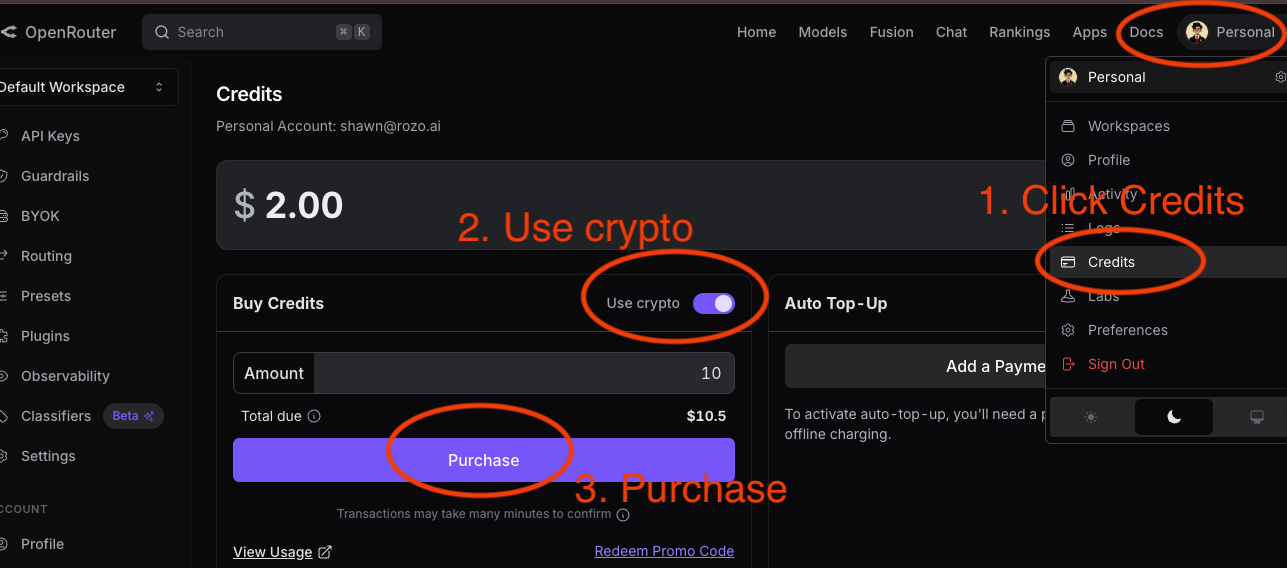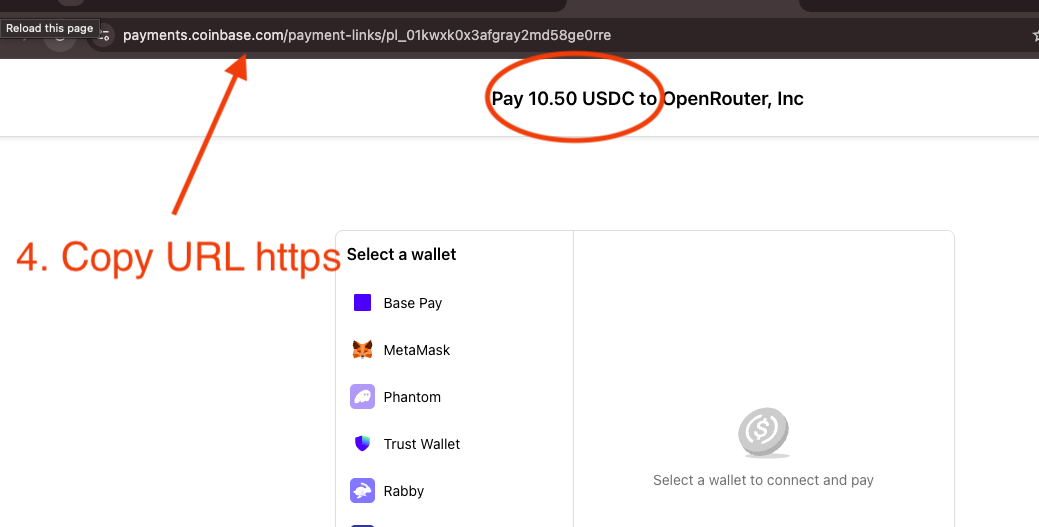
OpenRouter credits are priced in USDC, but if the stablecoins you hold live in a Solana wallet, you should not have to bridge or convert them first. With ROZO Checkout you connect your Solana wallet and pay OpenRouter directly with USDC or USDT on Solana.
This is a wallet-connect flow. You approve the payment inside your own wallet, with no manual address copy-paste, and credits land automatically. ROZO currently charges no service fee while we validate the flow.
Below: the exact steps, which wallets and tokens work, how fast it lands, what the SOL gas requirement actually means, and what to do if something looks stuck.

Does OpenRouter accept Solana directly?
Not as a Solana payment. OpenRouter's balance is denominated in USDC and its own crypto payment path charges 5%. Holding USDC on Solana does not exempt you from that, because the issue is not which stablecoin you hold, it is which rail the payment arrives on and what fee sits on the route.
The conventional workaround is a bridge. You move USDC from Solana to whichever chain the payment path expects, pay the bridge fee, wait for it to land, and then top up. That is an extra hop, an extra fee, and an extra opportunity for something to go wrong with a chain selection or a destination address.
ROZO Checkout removes the hop. You connect your Solana wallet directly to the payment window, pick USDC on Solana or USDT on Solana, and approve. The settlement to USDC that OpenRouter expects is handled on ROZO's side, not yours.
Because it is wallet-connect rather than send-to-address, there is no deposit address to copy, no memo to remember, and no way to send to the wrong chain by accident. The transaction your wallet asks you to sign is constructed by the checkout for the exact order amount.
What it costs
OpenRouter's own crypto payment path charges 5%.
ROZO currently charges no service fee while we validate the flow.
On Solana the only other cost is the network fee, which is a fraction of a cent paid in SOL and goes to the Solana network rather than to ROZO. That is why the checkout asks you to keep a small amount of SOL in the wallet even though the payment itself is denominated in USDC or USDT.
This is the cheapest kind of comparison to reason about because both sides are stablecoins. If you top up $200, the difference between a 5% path and a no-service-fee path is $10 of API credits that either exist or do not. Nothing about exchange rates, spreads, or slippage enters the picture, because USDC on Solana and the USDC OpenRouter bills in are the same dollar.
The order is priced in USDC, so the USD value of what you owe is fixed when the order is created. Paying with USDT on Solana instead of USDC credits the same amount.
Pay OpenRouter with USDC on Solana
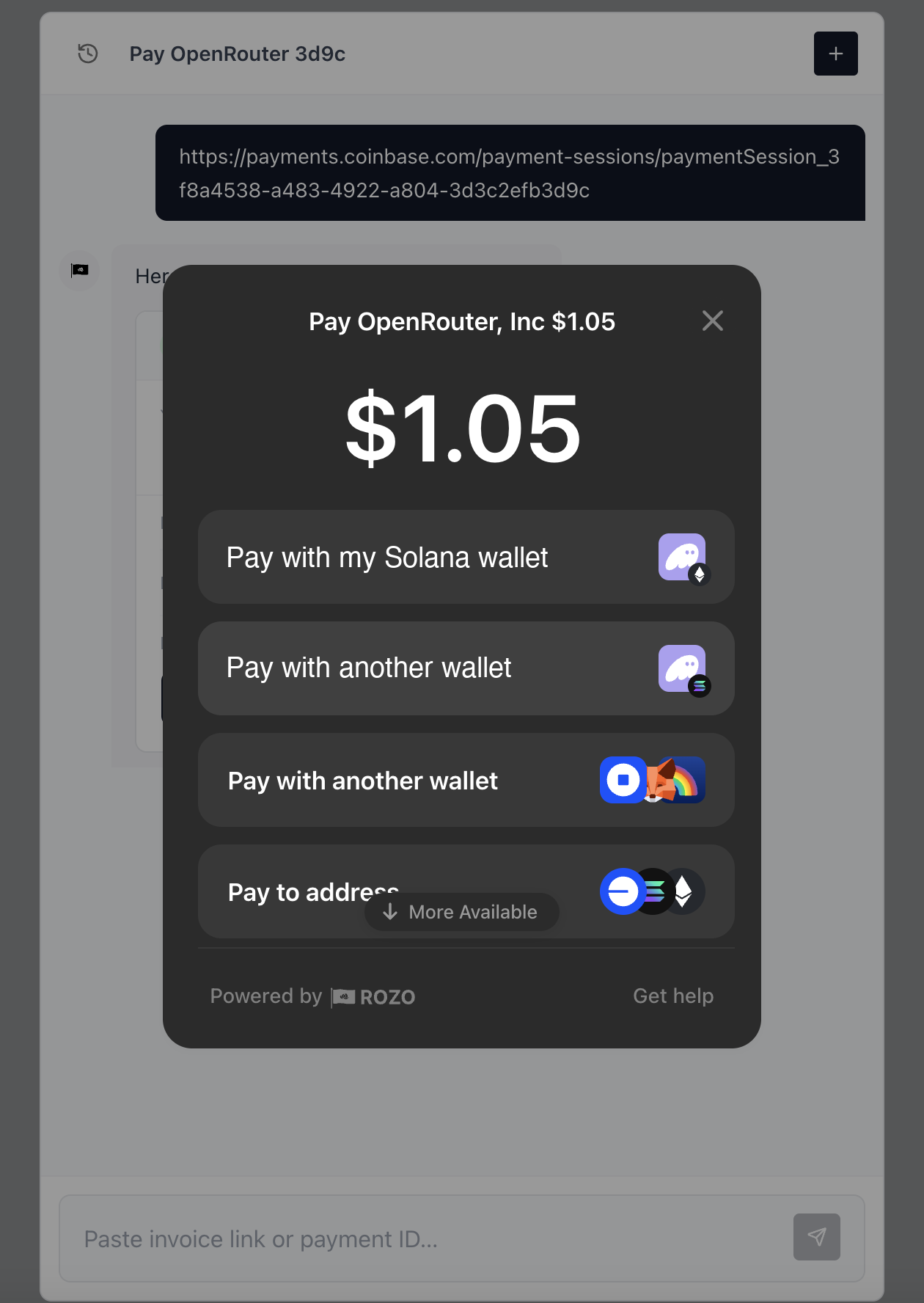
- Paste your OpenRouter payment link or payment ID, for example pl_01kyaaevc7evgt9, into ROZO Checkout.
- A Pay OpenRouter, Inc window opens and connects your Solana wallet. Phantom, Solflare, and Backpack are supported.
- Pick your token: USDC on Solana or USDT on Solana. A live balance check shows Balance too low if you are short. Need a different chain or token? Tap Pay with another method.
- Approve the payment inside your wallet. Credits usually arrive automatically within about 30 seconds.
Step 3 is where most confusion gets caught before it becomes a problem. The live balance check reads your actual token balances, so if you thought you had enough USDC on Solana but the balance is short, you find out before signing rather than after a failed transaction. Switching to USDT on Solana at that point is one tap.
Step 4 happens entirely inside your wallet. Phantom, Solflare, and Backpack will each show you the transfer they are being asked to sign, including the token and the amount, so you can confirm it matches the order before approving.


Which wallets and tokens work
Any popular Solana wallet works: Phantom, Solflare, or Backpack. You can pay with USDC on Solana or USDT on Solana, whichever you already hold. Keep a small amount of SOL in the wallet for the network fee. Because the checkout drives the transfer through your connected wallet, there is nothing to copy and no address to get wrong.
Phantom is the most common choice and works as both a browser extension and a mobile app, so the same wallet covers a desktop checkout and a phone checkout. Solflare works the same way and is a frequent pick for people who also stake SOL. Backpack is fully supported and behaves identically in the payment window.
On tokens, the choice between USDC on Solana and USDT on Solana is purely about what you happen to be holding. Both are accepted, both credit the same USD value, and neither one is faster or cheaper than the other on this route. If you hold both, pick whichever leaves your balances tidier.
The one requirement that catches people is SOL. A wallet holding $500 of USDC and zero SOL cannot pay, because it cannot cover the network fee. That fee is a fraction of a cent, so a very small SOL balance is enough, but it cannot be zero.
How long it takes
Credits usually arrive automatically within about 30 seconds, once the payment confirms on-chain.
Solana is fast, and in practice the on-chain confirmation is the quick part. The 30-second figure covers the round trip: your wallet broadcasts the transfer, Solana confirms it, and the credit is applied to your OpenRouter balance. You do not need to keep the tab in focus or click anything to complete it.
This makes Solana one of the faster routes available in ROZO Checkout, second only to Stellar, which confirms in a few seconds. For comparison, Bitcoin over Lightning usually credits in about 3 minutes.
If you are past a minute and nothing has appeared, the first thing to check is whether the transaction actually went out. Open your wallet's activity view. If there is no transaction there, the approval did not complete, which most often means the wallet popup was dismissed or the SOL balance was insufficient to cover the fee. In either case nothing was sent, nothing was lost, and you can simply try again.
Why it is priced in USDC
OpenRouter bills in USD and settles in USDC. ROZO Checkout locks the USD value of your order, so paying with USDC or USDT on Solana credits the same amount. The settlement to USDC happens for you, so you never convert manually first.
On a stablecoin-to-stablecoin route this mostly means one thing in practice: there is nothing to watch. You are not exposed to a price that could move between opening the window and approving the transaction, and there is no rate quote with a countdown on it. The order says an amount in USDC, you send that value in USDC or USDT on Solana, and that value becomes credits.
It also explains why USDT is accepted at parity here. The order's USD value is what is being satisfied, so sending USDT on Solana against a USDC-denominated order is a supported path rather than a conversion you are being charged for.
ROZO is independent and is not affiliated with OpenRouter. This is a third-party checkout that accepts Solana-native stablecoins and delivers the USDC that OpenRouter expects.
If credits do not arrive
Wait out the window first. Credits usually arrive within about 30 seconds, so give it a minute before treating anything as stuck.
Then open your Solana wallet's activity list and look for the transfer. This single check resolves most cases. If the transaction is not there, the payment never went out, and you can retry after confirming you have a small amount of SOL for the network fee. If the transaction is there and confirmed, the payment did go out and it is a matter of reconciliation rather than a lost payment.
Copy the transaction hash. Phantom, Solflare, and Backpack all let you copy it in one tap from the activity entry. That hash is the definitive record of what was sent, in which token, and to where.
Contact support with the transaction hash and your OpenRouter payment link or payment ID. Those two together identify both sides of the transaction and are enough to trace and resolve it. Do not send a second payment while you are waiting on the first, because a confirmed Solana transfer cannot be reversed and you would simply have paid twice.
Is it safe, and who is ROZO?
Solana is the wallet-connect route, which is the safest shape a crypto payment can take. Your keys never leave your wallet. The checkout constructs a transfer and asks your wallet to sign it, and your wallet shows you the token and the amount before you approve. Nothing is deducted without you pressing confirm inside Phantom, Solflare, or Backpack.
This also eliminates the failure mode that costs people the most money in crypto payments: sending to a wrong or wrong-chain address. There is no address to paste, because the transfer is constructed for you. There is no chain to select in your wallet, because you connected a Solana wallet and the payment is a Solana transaction.
ROZO Checkout does not hold a balance for you and there is no account to create. It is a payment surface that takes your OpenRouter payment link, accepts a Solana-native stablecoin, and settles the result to USDC.
On pricing, the position is stated plainly. OpenRouter's own crypto payment path charges 5%. ROZO currently charges no service fee while we validate the flow. ROZO is independent and is not affiliated with OpenRouter, Coinbase, or Boltz.