
The minimum is only half the story. The other half is the fee: 5% on crypto, 5.5% on card with a $0.80 minimum fee. Put the two together and the cheapest-looking option, $5 by card, is the most expensive one per dollar. This page does the arithmetic for $5, $10, $20 and $100 so you can pick an amount on purpose.
Figures verified against OpenRouter's FAQ and checkout on 14 September 2026. OpenRouter changes pricing without notice; the date at the top tells you when this was last re-checked.
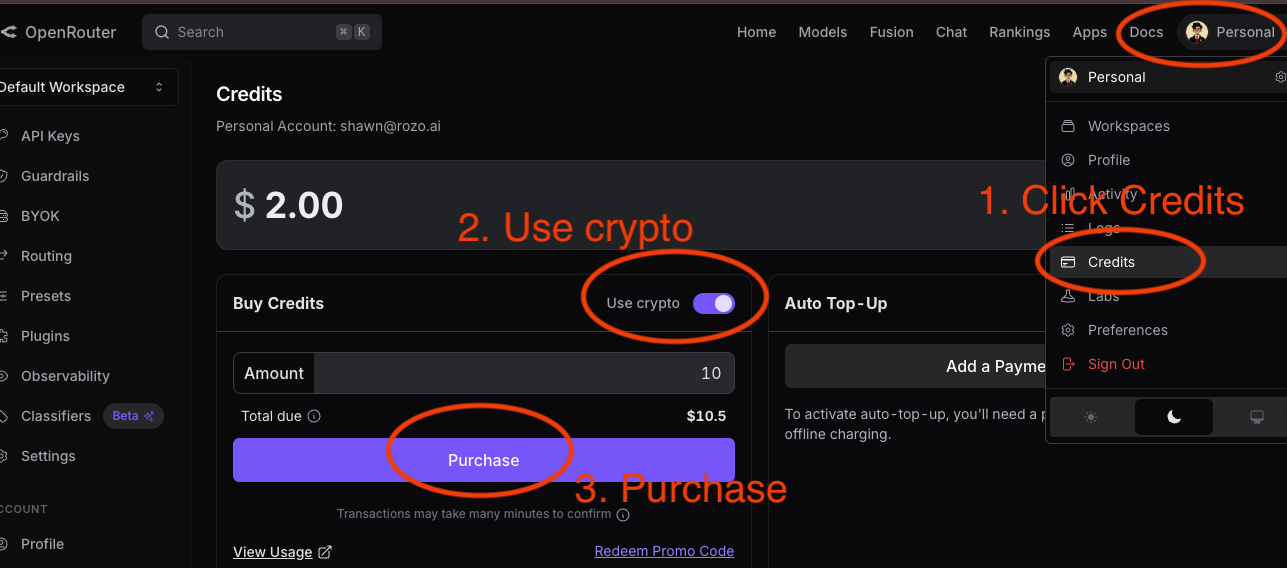
The two minimums, side by side
- Crypto (USDC via the Coinbase checkout page): $10 minimum. Fee 5%. Never refundable, per OpenRouter's FAQ.
- Card or AliPay (Stripe): $5 minimum. Fee 5.5%, with a $0.80 minimum fee. Some countries add VAT on top.
Both numbers are OpenRouter's, not ours. The crypto minimum is enforced on the payment link OpenRouter generates, which matters later: anything that settles that link, ROZO included, inherits it.
What each top-up actually costs
Each line is the amount of credits you want, followed by what is charged. Card lines exclude VAT, which some countries add on card purchases.
- $5: by card $5.80 (the $0.80 minimum fee applies). By crypto: not available, the minimum is $10.
- $10: by card $10.80 (the $0.80 floor still applies, because 5.5% of $10 is only $0.55). By crypto $10.50.
- $20: by card $21.10. By crypto $21.00.
- $100: by card $105.50. By crypto $105.00.
The card floor stops mattering once 5.5% of the purchase exceeds $0.80, which happens a little above $14.50. Below that line the card fee is a flat 80 cents, and the smaller the top-up the bigger that 80 cents is as a share of it.
Why $5 by card is the worst deal
$0.80 on $5 is 16%. That is almost three times the advertised 5.5%, and more than three times the 5% crypto rate. It is the single most expensive way to buy OpenRouter credits per dollar, and it is the default many people land on because $5 is the smallest number the card form accepts.
If you can stretch to $10, the picture changes. $10 by crypto costs $10.50, an effective 5%. $10 by card costs $10.80, an effective 8%, because the floor still bites. At $20 the two routes are ten cents apart, and from there on the difference is the half a percent between 5% and 5.5%.
What the $10 minimum means if you pay through ROZO
ROZO Checkout sets no minimum of its own. It settles the payment link OpenRouter generated, and that link already carries the amount and OpenRouter's 5% fee. So the $10 crypto minimum carries over unchanged: ROZO cannot pay a $5 crypto top-up because OpenRouter does not issue a $5 crypto link.
What ROZO changes is the coin and the chain. The same $10 link can be paid with Bitcoin over Lightning, USDC or USDT on Solana, Ethereum, BNB Chain or Polygon, or USDC on Base or Stellar, with no card, no ROZO account and no KYC. ROZO charges a 1% service fee on the link amount, shown before you send anything, and the chain's own network fee is separate. On Solana and Stellar that network fee is a fraction of a cent.
Crypto purchases stay non-refundable on this route too, because the credits are issued by OpenRouter under OpenRouter's terms.
Which amount to pick
- Under $10: card is the only option, and you will pay the $0.80 floor. Consider waiting until you can top up $10.
- $10 to $20: crypto is cheaper in absolute terms and avoids the floor. If you hold a coin OpenRouter's Coinbase page does not take, ROZO settles the same link from the chain you are on.
- $20 and up: the difference between the two OpenRouter routes is the half a percent between 5% and 5.5%. Pick on convenience. Cards buy auto top-up and dispute rails; crypto buys a lower rate and no card at all.
- Any amount: never send a crypto payment expecting a refund. OpenRouter states cryptocurrency payments are never refundable.