
That pattern is not a bank decline. It is the payment processor's fraud screen rejecting the attempt before it ever reaches your bank, which is exactly why nobody at the bank can find it.
Why your bank has no record
OpenRouter takes cards through Stripe. Before Stripe sends a charge to the card network, its risk system scores the attempt. If the score trips a block rule, Stripe returns a generic decline to the merchant and never contacts the issuer. From your bank's point of view the transaction never existed.
The score is built from signals you cannot see or fix from your side: the merchant's recent fraud rate, the card's BIN, mismatches between your IP and billing country, and how many attempts came from the same device. When a merchant is under a card-testing attack, legitimate cards from the same regions get blocked as collateral, which is why these reports arrive in clusters on the same day.
OpenRouter support said the same in October 2026, in public, to a user whose card payments never showed up at the bank: none of the payments reached the bank, Stripe's fraud screening blocked them before they were sent, and it is a risk score on each payment, not a setting on the account. The same reply noted that the user's crypto top-up had gone through.
What usually does not help
Retrying the same card. Each retry adds to the attempt count and pushes the score further the wrong way.
Trying a second card from the same device and network. The device and IP signals are unchanged, so the same rule fires.
Calling the bank. They have nothing to unblock, because they never saw the charge.
Waiting on a support ticket. Billing queues can sit for days, and no answer restores the card path.
What does help: leave the card rail entirely
A risk block applies to card payments. OpenRouter also sells credits for crypto, and that path never touches the card fraud engine at all.
The catch is that OpenRouter's crypto option expects USDC and generates a payment link for it. If your funds sit on another chain, in another token, or on an exchange, you still need a way to settle that link. That is what ROZO Checkout does.
Pay the OpenRouter link with the coin you already hold
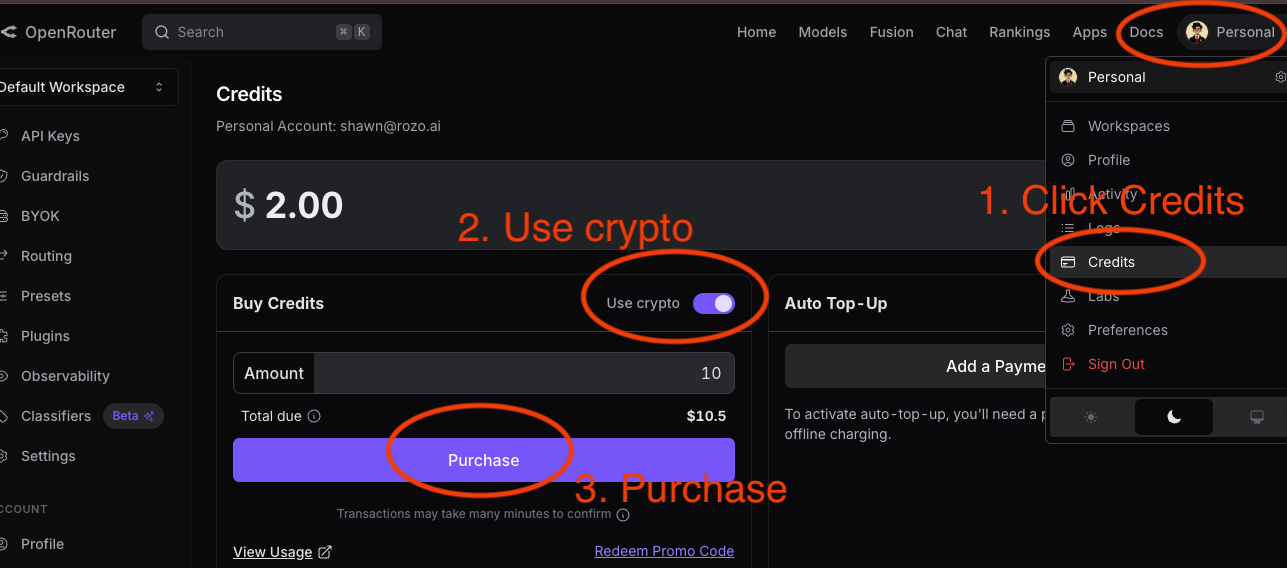
- In OpenRouter, open Settings then Credits, turn on the crypto option, enter the amount and click Purchase. Copy the payment link it generates.
- Paste the link at checkout.rozo.ai.
- Pick what you actually hold: USDT or USDC on Solana, BNB Chain, Ethereum, Polygon or Arbitrum; USDC on Base or Stellar; or Bitcoin over Lightning. Native coins work too: ETH on Ethereum, Base or Arbitrum, BNB on BNB Chain, SOL on Solana and POL on Polygon. ZEC on Zcash is in Beta and has its own page: checkout.rozo.ai/zec.
- Send the quoted amount from your own wallet, or withdraw it from your exchange to the one-time deposit address shown. ROZO settles the OpenRouter link and the credits land on your account.
There is no ROZO account, no card, and no KYC form. The order is priced in USD, so what you owe does not move with the coin. OpenRouter's own crypto fee of about 5% still applies because it is built into the link, and ROZO charges a 1% service fee, shown before you pay.