
QuickNode's own checkout takes cards through its billing page. ROZO Checkout sits in front of that page instead: you get the Coinbase-hosted crypto payment link from your QuickNode billing settings, paste it into ROZO Checkout, and pay from whichever chain your funds actually sit on (Solana, Base, BNB Chain, Ethereum, Stellar USDC/USDT, or Bitcoin over Lightning). ROZO charges a 1% service fee, shown before you pay.
This is not a QuickNode integration and it does not touch your QuickNode account settings. It is a third-party checkout that accepts the crypto payment link QuickNode's own billing page already generates and lets you settle it from a chain and wallet of your choosing.
What is QuickNode, and why pay it with crypto?
QuickNode provides managed RPC nodes and blockchain infrastructure APIs across dozens of chains: Solana, Ethereum, Base, BNB Chain, and more. Teams building wallets, indexers, trading bots, or dapps use it instead of running their own nodes, and the invoice is typically usage-based, billed monthly.
The irony is not subtle: a company selling blockchain infrastructure bills you in dollars through a card processor by default. If your operating funds are already denominated in the chains QuickNode itself serves, converting back to fiat just to pay a blockchain infrastructure bill is a round trip that costs time and, depending on your on-ramp, a spread or a fee.
QuickNode does offer a Coinbase-powered crypto payment option on its own billing page. ROZO Checkout does not replace that option: it sits in front of the same payment link and widens which chain and wallet you can pay from, so a team holding Solana USDC or BNB Chain USDT is not forced to route through whatever chain the direct crypto checkout defaults to.
Pay QuickNode with crypto, step by step
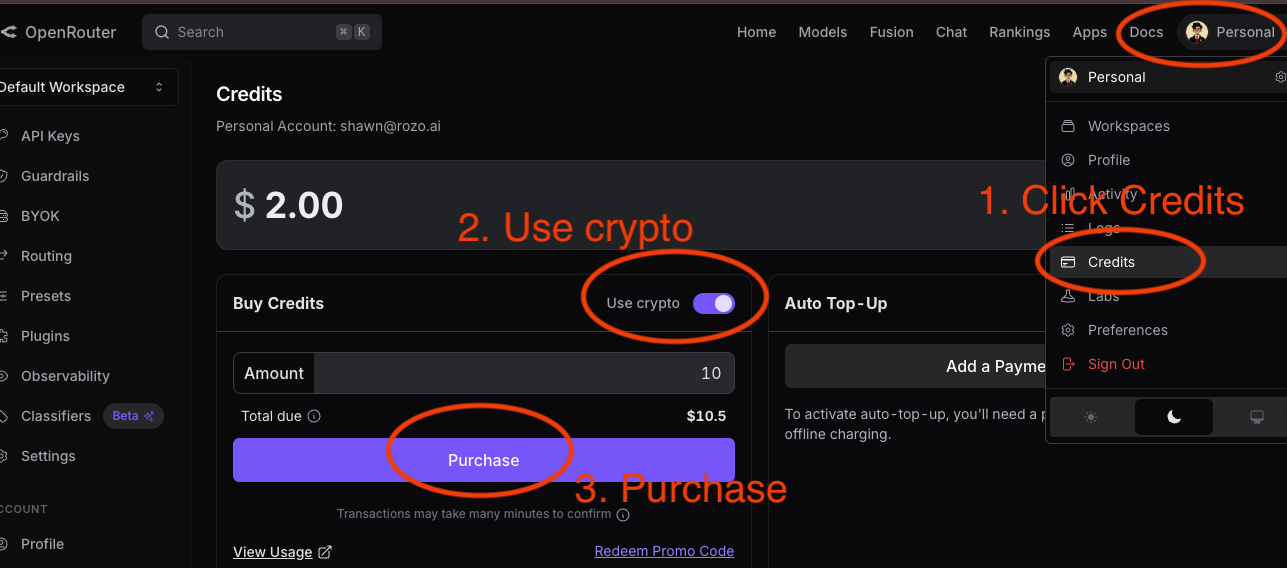
- Log in to your QuickNode dashboard, open Billing, and choose the crypto payment option. This generates a Coinbase Commerce-style payment link for your invoice amount.
- Copy that payment link.
- Go to checkout.rozo.ai/services/quicknode and paste the link.
- Pick the chain you want to pay from: Solana, Base, BNB, Ethereum, Stellar USDC/USDT, or Bitcoin Lightning.
- Confirm the amount shown matches your invoice, then approve the payment in your wallet.
On a wallet-connect chain (Solana, Base, BNB, Ethereum) your wallet shows you the token and amount before you sign, and nothing moves until you approve. On Stellar and Lightning you pay a standard payment request from your own wallet. Either way, ROZO does not hold a balance for you and there is no ROZO account to create: your funds move from your wallet directly to the payment link QuickNode's own billing page generated.
Which chains and wallets work
checkout.rozo.ai/services/quicknode supports Solana (Phantom, Solflare, Backpack), Base (MetaMask, Rabby, Coinbase Wallet), BNB Chain (MetaMask, Rabby, Trust Wallet), Ethereum mainnet, Stellar USDC/USDT (Lobstr, Freighter, or any Stellar wallet), and Bitcoin over the Lightning Network (any Lightning wallet: Wallet of Satoshi, Phoenix, Muun, Breez).
Ethereum mainnet works but its gas cost is disproportionate on smaller invoices; it suits a larger QuickNode bill better than a small one. On every EVM chain, keep a small amount of the native gas token (ETH, BNB) in the wallet alongside your USDC or USDT: the payment itself is in the stablecoin, but the network fee is paid separately in the chain's gas token.
The invoice amount is fixed in USD by QuickNode's own billing page before you ever reach ROZO Checkout, so switching chains or tokens does not change what you owe: it only changes which balance you draw it from.
How long it takes
Settlement speed depends on the chain, same as any crypto payment: Stellar confirms in a few seconds, Solana and Base usually land within about 30 seconds, BNB Chain and Ethereum land once the transaction confirms (typically quick, but dependent on network congestion), and Bitcoin over Lightning usually credits in about 2 minutes.
Because the payment settles through the same Coinbase-hosted link QuickNode's billing page already generated, QuickNode sees the payment the same way it would if you had paid through its own crypto checkout directly: you are not routing around QuickNode's billing system, only around the specific chain and wallet its default flow expects.
If your QuickNode invoice does not update after the payment confirms on-chain, that is a reconciliation question for QuickNode support, and having your transaction hash ready is the single most useful thing you can hand them.
Is it safe, and who is ROZO?
On Solana, Base, BNB Chain, and Ethereum, this is a wallet-connect flow: your keys never leave your wallet, and you see the exact token and amount before you sign. On Stellar and Lightning, you are paying a standard payment request that shows the amount up front. There is no deposit address to hand-copy on the EVM or Solana routes, which removes the single most expensive mistake in crypto payments: sending to the wrong chain.
ROZO Checkout does not hold a balance for you, and it does not modify anything in your QuickNode account. It reads the payment link QuickNode's own billing page already produced and lets you settle it from a chain of your choosing. ROZO is independent and is not affiliated with QuickNode or Coinbase.
ROZO charges a 1% service fee, shown before you pay. If that changes, it will be stated plainly.