
This question showed up from people in the OpenRouter community in the last days of August 2026, usually right before sending rather than after. That is the correct time to ask.
The short answer: Base, at the time of writing
At the time of writing, OpenRouter's crypto option hands the payment off to a Coinbase-hosted checkout, and the payment link it produces accepts USDC on Base, not USDC on Ethereum mainnet, Solana, Polygon or Arbitrum. One asset, one network. Payment methods change without notice, so check the current payment page before you send.
This trips people up because the deposit address on the page looks like an ordinary Ethereum address. Base is an EVM chain, so addresses on Base share the same format as addresses on Ethereum, Polygon, BNB Chain and Arbitrum. Your wallet will happily let you send to that string on any of them. The address being valid tells you nothing about whether the funds land where the invoice is watching.
How to check before you send, not after
Do not rely on memory or on this article. Confirm it on the page in front of you:
- Open the payment link OpenRouter generates and look for the asset and network labels shown alongside the deposit address. Whatever the page tells you there is the authority, not this article.
- If you are withdrawing from an exchange, the exchange's withdrawal form asks for the network as a separate field from the address. Select the one the payment page names. If Base is not in that exchange's withdrawal list, stop: that exchange cannot deliver to this link directly.
- If your wallet shows a network picker at the moment of sending, check it against the page one more time. Wallets default to whichever chain you used last.
Checking is worth the trouble, because a wrong-network send may be unrecoverable.
What happens if you send on the wrong chain
The transfer still exists at that address on whichever network you used, but the invoice is not watching that network, so nothing gets credited and your OpenRouter balance does not move. Whether anyone can retrieve it depends on who controls that address on the other chain, and that is not something you can determine from the outside: treat a wrong-network send as potentially unrecoverable rather than as a delay. If it happens, the only path is to contact the support channels for the checkout you were paying.
Retrying on the correct chain means sending another payment. The first one does not automatically follow you over.
What does not solve the problem
- Bridging your USDC to Base yourself. This works, but it means a bridge fee, gas on two chains, and a wait: for a payment you were trying to make in one step.
- Buying Base USDC on an exchange that does not support Base withdrawals. You end up with the right asset stranded on the wrong rail.
- Sending native ETH, SOL, BNB or POL instead. At the time of writing the invoice is denominated in a stablecoin and will not settle from a native-token transfer.
Paying the same link from the chain you are already on
If your money is not on Base, the fix is to let something else settle the Base side. That is what ROZO Checkout does: it takes the exact link OpenRouter generated and pays it, while you pay in the coin and network you actually hold.
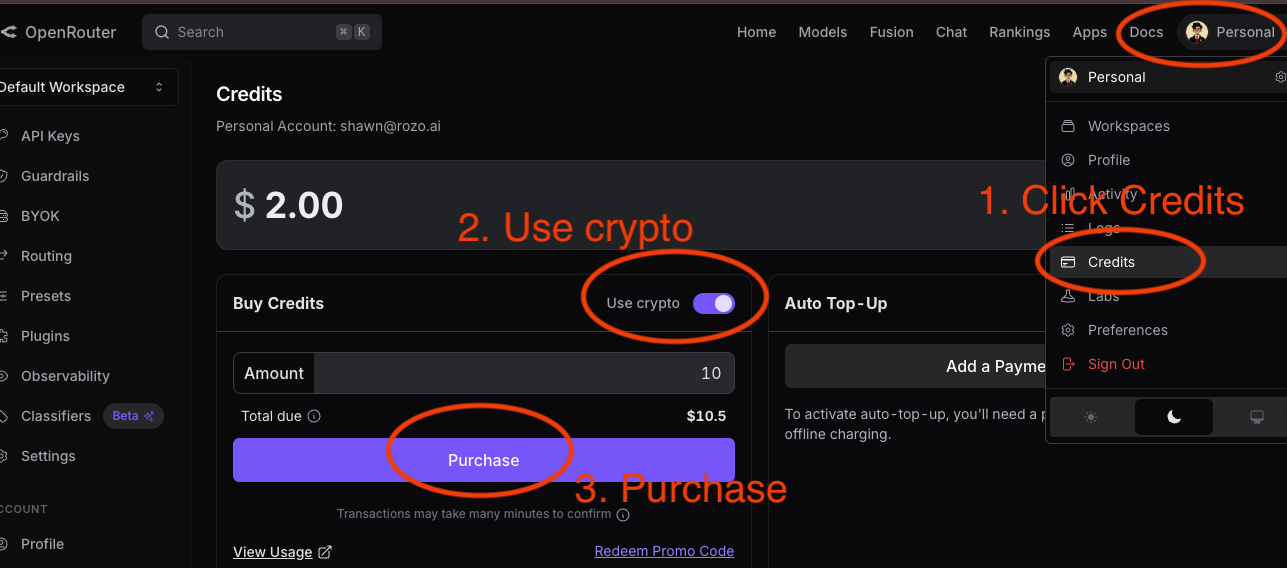
- In OpenRouter, open Settings then Credits, turn on the crypto option, enter the amount and click Purchase. Copy the payment link it produces.
- Paste that link at checkout.rozo.ai.
- Choose what you hold: USDT or USDC on Solana, BNB Chain, Ethereum, Polygon or Arbitrum; USDC on Base or Stellar; or Bitcoin over Lightning.
- Send the quoted amount to the one-time deposit address shown, or pay the Lightning invoice. ROZO's page tells you the exact coin, network and amount to use, so you are not guessing at the network. A funder wallet then settles the invoice. Credits are applied after the payment settles on chain; the ROZO payment page shows live status until it does.
There is no ROZO account, no card and no KYC. ROZO enforces no minimum of its own; OpenRouter's validation on the link still applies.
On cost: OpenRouter charges its own crypto fee, around 5% as listed on OpenRouter's FAQ at the time of writing, and that is already built into the link amount. ROZO charges a 1% service fee on top, shown before you send anything. Network fees on the chain you send from are separate again.
Native coins are accepted too: ETH on Ethereum, Base or Arbitrum, BNB on BNB Chain, SOL on Solana and POL on Polygon. ZEC on Zcash is in Beta and has its own page: checkout.rozo.ai/zec. A native coin order carries the 1% service fee plus an FX spread on the coin price, built into the coin amount. On-chain Bitcoin is not accepted; Bitcoin goes over Lightning rather than the base chain. For the Bitcoin route, any wallet that can pay a standard Lightning (BOLT11) invoice will work.