
This page collects what OpenRouter's own documentation says, as checked on 10 October 2026, and what records a crypto top-up leaves if you pay that way. It is not tax advice, and OpenRouter can change any of this; check its pages before you rely on them.
ROZO is independent and is not affiliated with OpenRouter, Coinbase or Stripe.
Where to enter your tax ID
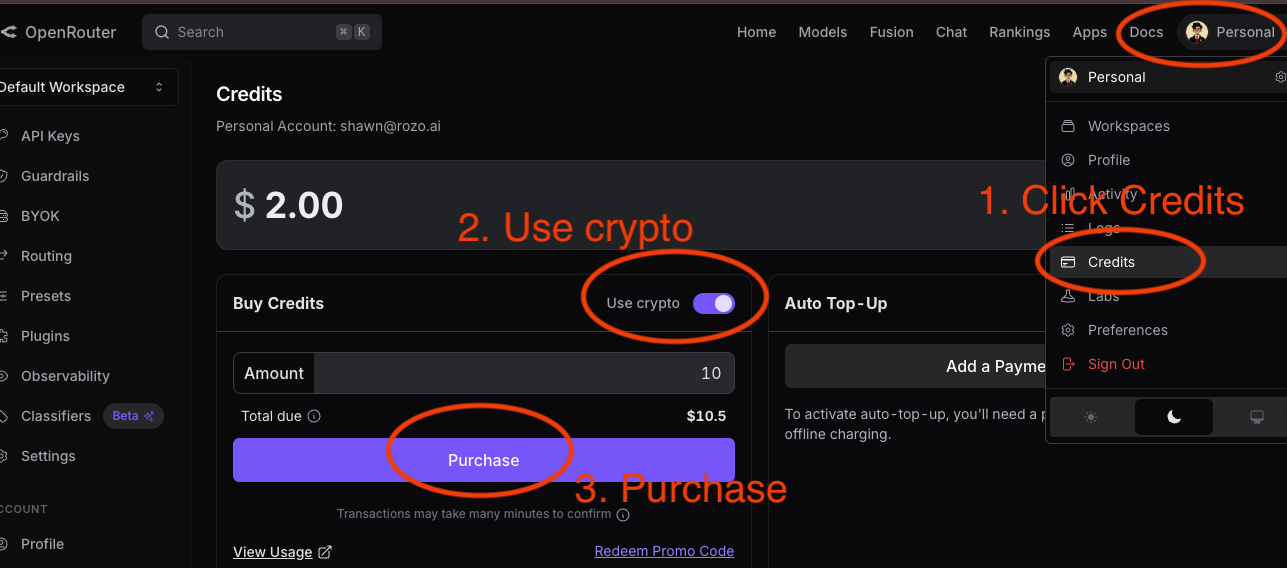
OpenRouter's tax ID guide says to open Settings then Credits, click Add Credits, and expand the Edit Tax ID section. You pick your country code, enter the number and save.
The guide says OpenRouter supports tax IDs from more than 50 countries through Stripe, with examples such as EU VAT, UK VAT, US EIN, Australian ABN, Canadian BN and Brazilian CNPJ. Enter it before you buy: the guide describes tax being calculated at purchase time.
How tax appears on the invoice
OpenRouter's pricing page says prices exclude applicable taxes and that VAT or GST may be added on invoices where required. Its tax ID guide says the tax is calculated automatically by Stripe and added to the invoice at purchase time.
In practice that means the card checkout can show a VAT or GST line on top of the credits and OpenRouter's fee. Our guide to VAT and GST at OpenRouter's checkout walks through the rates readers have seen and how a tax line changes the total.
Can you pay by bank transfer or purchase order?
As of 10 October 2026, OpenRouter's pricing page lists credit and debit cards, AliPay and crypto (USDC) for its Standard and Business plans, and says Enterprise customers get invoicing and purchase orders through sales. We did not find a self-serve bank transfer option on its pricing page or FAQ.
So if your finance team needs to pay against an invoice by bank transfer, the documented route is to contact OpenRouter's sales team about an Enterprise plan. A third-party checkout cannot turn a card top-up into a bank-transfer invoice for you.
Fees and refunds to know before you buy
- OpenRouter's pricing page lists its fee on credit purchases as 5.5% on Standard and 8% on Business, charged when you buy credits rather than per request. Its FAQ lists 5% on crypto payments, and the card fee has a $0.80 minimum.
- Its terms allow refunds of unused credits only if requested within 24 hours, and say cryptocurrency payments are never refundable.
- Credits can expire 365 days after purchase.
Plan the top-up size around those rules rather than buying a year of credits at once.
What a crypto top-up leaves for your records
OpenRouter's crypto option creates a Coinbase payment link for the order. In the OpenRouter crypto links we handled up to October 2026, the amount was the credits plus OpenRouter's crypto fee of about 5%, with no tax line.
If you pay that link through ROZO Checkout, keep three things together for your records:
- The OpenRouter payment link or payment ID.
- The on-chain transaction hash, or the Lightning payment record.
- The receipt link ROZO Checkout shows once the payment is received, which lists the order.
That receipt is a record of the payment, not a VAT or GST invoice from OpenRouter. ROZO charges a 1% service fee, shown before you pay. If your company needs an invoice in its own name with tax shown, the card path with a tax ID or an Enterprise agreement with OpenRouter is the route to look at.