
The obvious next step seems to be OpenRouter's crypto option. Then you see that it does not take your coin either. This guide covers that gap, which is narrower than the decline itself: how to turn BNB Chain USDT into the same OpenRouter top up without a card.
If you still want to know why the card failed, our guide on what to do when OpenRouter declines your card covers the diagnosis: bank declines, fraud checks and country restrictions. This page assumes you are done with the card and want to pay another way.
Why your USDT does not work on OpenRouter's crypto checkout
OpenRouter sells credits for crypto through a Coinbase Business checkout, and Coinbase's documentation says those checkouts currently accept USDC on Base. That rules out USDT on any network, and USDC on BNB Chain as well.
So people who switch from a declined card to crypto often hit a second wall. The checkout opens, and the coin they actually hold is not an option. The usual workaround has several steps: swap USDT to USDC, bridge from BNB Chain to Base, get a little of the network's fee coin on Base, then pay. Each step has its own cost and its own chance to send funds to the wrong network.
What usually does not help
- Retrying the same card: if nothing about the card or the charge has changed, a retry is unlikely to change the answer.
- Sending BEP-20 USDT toward the Coinbase checkout: it expects USDC on Base, so a transfer in another token or on another network is not a valid payment for it.
- Bridging by hand under time pressure: it works, but it takes several transactions, fees on two networks and careful address checks. If you only need a top up, that is a lot of moving parts.
What does help: pay the link with the coin you hold
You do not need to change what you hold. You need something that accepts BNB Chain USDT and settles OpenRouter's USDC on Base checkout for you. That is the job ROZO Checkout does.
ROZO reads the OpenRouter payment link and creates a one time order with a deposit address for the coin you choose. Once your deposit lands, it pays the Coinbase invoice, and OpenRouter adds the credits as if you had paid in USDC on Base. The order is priced in USD, so the amount you owe does not move while you send. ROZO charges a 1% service fee, shown before you pay. You do not need a ROZO account, a card or KYC.
One distinction matters. USDT on BNB Chain and BNB, the chain's native coin, are different orders. This guide is about USDT on BNB Chain.
The route, step by step
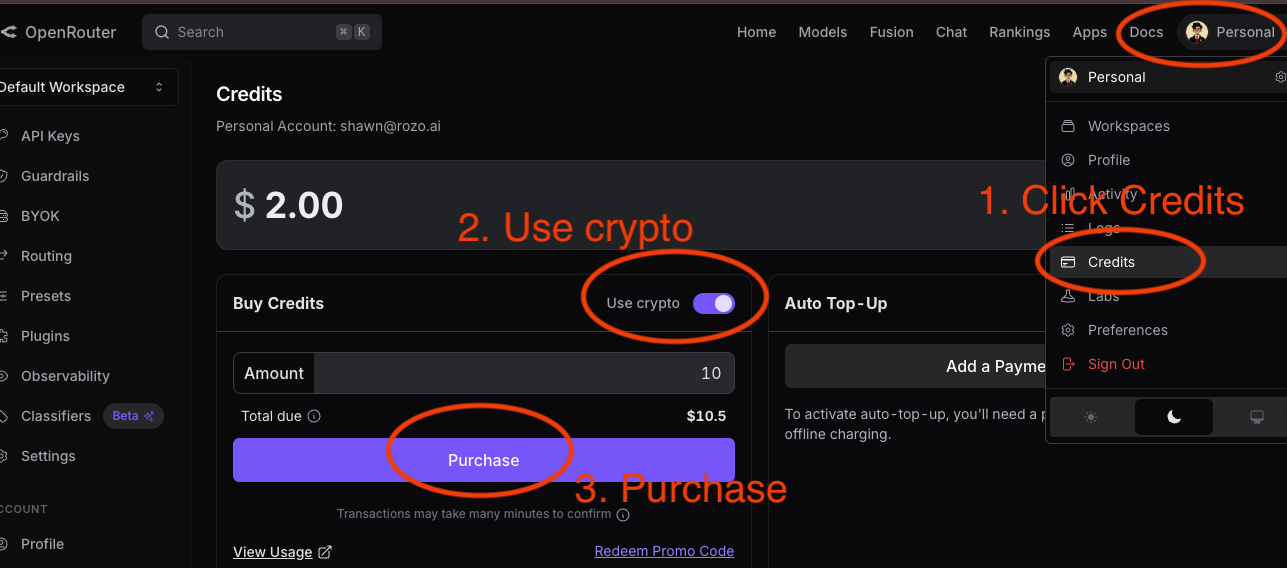
- In OpenRouter, open the Credits page, choose the crypto option, enter the amount you want and continue. Copy the payment link it generates.
- Open checkout.rozo.ai and paste the link.
- Choose USDT as the coin and BNB Chain as the network. Check that the invoice amount shown matches your OpenRouter link. The total to send is that amount plus ROZO's service fee.
- Send the quoted amount of BEP-20 USDT to the one time deposit address shown. From a self custody wallet such as Trust Wallet, keep a little BNB for the network fee, because fees on BNB Chain are paid in BNB. From an exchange, pick the BEP-20 or BSC network when you withdraw, and make sure the amount that arrives covers the quote after any withdrawal fee the exchange charges.
- Once the deposit confirms on BNB Chain, ROZO settles the OpenRouter link and the credits appear in your account.
Use the deposit address for this one order only, and generate a fresh OpenRouter link for every new top up.
For the wallet screens, see our guides to paying OpenRouter with BNB Chain and paying OpenRouter from Trust Wallet on BNB Chain.
ROZO is independent and is not affiliated with OpenRouter, Coinbase or Trust Wallet.