
When that happens, the most useful thing you can work out is which page actually took your payment, because that decides who can trace it. This page explains how to tell, and what to send to whom. ROZO is independent and is not affiliated with OpenRouter, Coinbase or Stripe.
Two reports, kept separate
These are user reports from OpenRouter's Discord. We do not know the outcome of either, and we are not saying what happened in them.
- Early October: a reader sent 10.88 USDT on Solana against a page showing $10.80 and got no credits. OpenRouter's support replied that the transaction was not sent to OpenRouter, that its crypto top-ups take USDC on Base through the Coinbase checkout, and that the funds were forwarded to a third-party payment processor. Support asked for the page address, said that a buyer who used a reseller should ask the reseller for a refund, and said that a page claiming to be OpenRouter may be a phishing site. Another user in the thread questioned that answer and said the screenshot looked like a Stripe page.
- Late September: a reader paid $5.80 in USDT on Solana and had no credits after five days. No support conclusion was posted in the channel.
OpenRouter has two official crypto pages
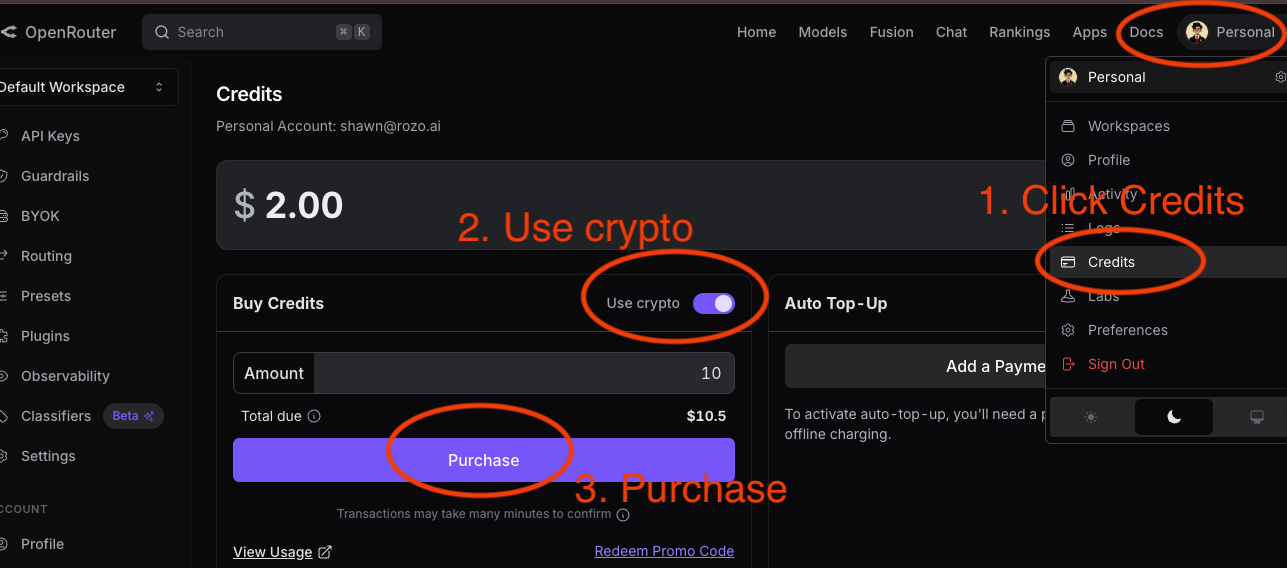
Both start from Settings then Credits in your own OpenRouter account, while you are logged in.
- The crypto option with Purchase creates a Coinbase payment page. Its address starts with payments.coinbase.com. OpenRouter's support describes this path as taking USDC on Base. The minimum is $10 of credits.
- The Crypto method inside the Stripe payment form creates a Stripe page whose address starts with crypto.stripe.com/pay/. That form adds OpenRouter's card fee, so $5 of credits shows as $5.80 and $10 as $10.80 before any tax. The Stripe page lists the networks it accepts.
If you started from your OpenRouter Credits page and paid on one of those two addresses, you paid OpenRouter's own checkout. Say that in your support ticket, with the page address.
If you paid somewhere else
Any other page is a third party: a reseller, an independent checkout such as ROZO Checkout, or a site pretending to be OpenRouter. They are not the same thing.
A legitimate independent checkout asks you to paste a payment link that you created in your own OpenRouter account, and your credits arrive only when that link is paid. If the page never asked for your OpenRouter payment link, it had no way to add credits to your account, whatever it showed after you paid.
If you bought from a reseller, the reseller is the one to ask for a refund. If the page claimed to be OpenRouter, send its address to OpenRouter support so they can look at it.
What to collect before you write to anyone
- The address of the page where you paid. Your browser history usually has it.
- The transaction hash and the network you sent on.
- The exact amount you sent and the amount the page showed.
- The OpenRouter payment link or payment ID, if the page gave you one.
- The email on your OpenRouter account.
With that, OpenRouter support can check whether a payment reached its checkout, and the operator of a third-party page can trace its side. Do not post the transaction hash together with your account email in a public channel.
If you paid through ROZO Checkout
ROZO Checkout only pays a payment link created in your own OpenRouter account, and it shows the link's merchant and amount before you pay. Credits usually arrive in roughly 30 to 90 seconds after the payment confirms; on Lightning, allow about 2 minutes.
If you paid through ROZO and the credits did not arrive, do not pay again. Go to rescue.rozo.ai with the payment link and the transaction hash and we will trace it.
How to avoid this next time
- Start every top-up from Settings then Credits in your own OpenRouter account, never from a link someone sent you.
- Before you send, check the page address and which network and token it asks for, and send exactly that.
- If you hold USDT or a network the official page does not take, use a checkout that takes your OpenRouter payment link, so the credits are tied to your account.